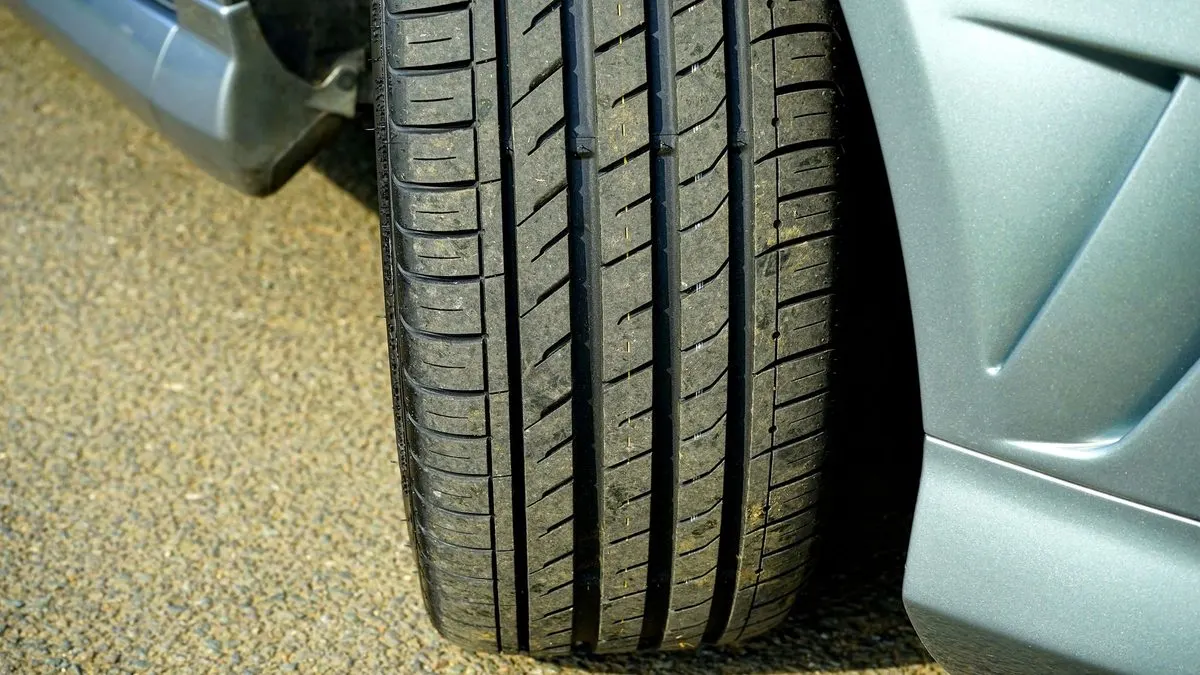
Uneven tyre wear is a diagnosis, the pattern tells you what's wrong. Fixing the underlying cause protects your new tyres; ignoring it just wears the next set out the same way. Run your hand and eye over each tyre and you can often spot the problem before a fitter even looks. Here's how to read the main patterns.
Both edges (shoulders) worn
Worn outer edges with a healthier centre usually means under-inflation. A soft tyre flexes too much, so the shoulders take the load while the centre lifts away from the road. Check your pressures first, as this is the most common and most fixable pattern, and the cheapest to prevent.
Centre worn, edges fine
A worn centre strip with healthy edges points to over-inflation. Too much pressure bulges the tyre in the middle so only the centre touches down and wears. Set the correct pressure from your door placard and the wear evens out going forward.
One edge only
Wear on a single inner or outer edge is the classic sign of misalignment, specifically camber or toe being out. It often appears after a pothole or kerb strike knocks the angles out, and it can ruin a tyre quickly if left, sometimes in just a few thousand miles.
Patchy or cupped wear
Scalloped, patchy wear usually means a balancing problem or worn suspension components such as shock absorbers. The wheel is effectively bouncing as it rolls, taking rubber off in uneven scoops. If new balancing doesn't fix it, the suspension is the next thing to check.
Feathered tread
Tread blocks worn sharp on one side, which you can feel by running a hand across the tyre, points to toe misalignment. It's a subtle one to see but easy to feel, and it's another reason to have alignment checked rather than just replacing the tyre.
How to read your own tyres
You don't need any tools to do a quick wear check. Look across the full width of each tyre, comparing the two shoulders and the centre, and run your palm gently across the tread in both directions to feel for feathering or cupping. Do it on all four, because the front and rear often wear differently, and the pattern on one corner can reveal a fault you'd otherwise miss. Combine it with the 20p test and you'll spot most problems early, while they're still cheap to fix. TyreSafe lists uneven wear as a key thing to check on every tyre.
Wear pattern quick reference
Match what you see on the tyre to the row below, check the simple thing first, and only then book the specialist.
| Where the wear is | Most likely cause | First thing to check | Who fixes it |
|---|---|---|---|
| Both shoulders | Under-inflation | Pressures against the placard | You |
| Centre strip | Over-inflation | Pressures against the placard | You |
| One edge, inner or outer | Camber or toe out of alignment | Recent pothole or kerb strike | Alignment specialist |
| Feathered blocks | Toe misalignment | Run a palm across the tread | Alignment specialist |
| Cupping or scallops | Imbalance or worn dampers | Vibration at speed; bounce test on each corner | Fitter, then garage |
| One tyre far faster than its axle partner | Dragging brake, bent wheel or a slow puncture | Heat at that wheel after a drive; pressure | Garage or fitter |
| Fronts faster than rears, evenly | Normal on front-wheel drive | Rotation history | Rotate |
Compare all four corners rather than one. The front pair and rear pair often tell different stories, and the odd one out is usually where the fault is.
When uneven wear is normal
Not all uneven wear means a fault; some of it is simply how the car is built and driven. Knowing the difference saves an unnecessary alignment bill.
- Fronts wearing faster than rears on a front-wheel-drive car is expected. The fronts steer, drive and do most of the braking. Rotation evens it out.
- Heel-and-toe wear, where each tread block is slightly higher at one end, is common on block-pattern tyres and on the non-driven axle. Mild heel-and-toe is normal; it becomes a problem only when it is severe enough to cause noise.
- Slightly more outer-shoulder wear on the fronts is typical for cars that see a lot of roundabouts, because the outside edge loads up in a bend.
- Mild inner-edge wear on the rears is a known characteristic of some cars with a lot of negative camber built into the rear suspension for handling. It is worth checking, but it may be within the maker's specification.
- Rears wearing faster on a heavily loaded van or tow car is a load pattern, not a fault, though pressures should be set for the load.
The test is symmetry. Wear that matches left to right on the same axle is usually a characteristic. Wear that appears on one corner only, or on one edge of one tyre, is a fault.
Is uneven wear illegal or an MOT fail?
Uneven wear itself is not illegal, but the legal tread limit applies to the worst part of the tyre, so a bald inner edge can make an otherwise decent tyre illegal.
The rule is 1.6mm across the central three-quarters of the tread width and around the entire circumference, as set out on GOV.UK. If wear has taken any part of that central band below 1.6mm, the tyre is illegal even if the rest reads 4mm, and the penalty is up to £2,500 and 3 points for each tyre. Wear confined to the outer shoulder, outside the central three-quarters, does not by itself put the tyre below the limit, but exposed cord anywhere on the tyre does make it unfit for use.
The MOT tyre check looks at exactly the same things: tread across the central band, cuts, bulges and exposed cord. Inner-edge wear is the classic surprise failure, because you cannot see it without turning the steering to full lock or getting underneath. Testers can and do. A tyre that fails for tread below 1.6mm, exposed cord or a bulge is illegal on the road, so have it replaced where the car is rather than driving it to a tyre shop.
A quick way to catch it at home is the 20p test on the inner, centre and outer grooves of each tyre, not just the groove you can reach easily.
Can an unevenly worn tyre be saved?
Sometimes. If the tread is still legal everywhere and the cause has been fixed, the tyre can often serve out its remaining life, possibly in a different position.
- Shoulder or centre wear from pressure: correct the pressure and keep the tyre. It will not regrow tread, but it stops wearing wrongly.
- Mild one-edge wear, tread legal all across: fix the alignment, then consider swapping the tyre to the other side of the axle so the worn edge sits on the outside, if the tyre is non-directional. This spreads the remaining wear.
- Cupping: once dampers or balance are sorted the noise may ease, but scalloped tyres rarely go back to smooth and are often replaced for comfort.
- Cord showing, tread below 1.6mm in the central band, or a bulge: replace, no exceptions.
When replacing, do it in axle pairs where you can, so the two tyres on that axle have similar grip and circumference. And get the alignment checked before or immediately after the new tyres go on, not months later.
Fix the cause, then the tyres
Replacing a tyre without fixing the cause just wastes money, because the new one wears the same way. We'll inspect the wear, advise on the likely cause, and replace tyres at your location, telling you what to get checked by a garage. Our only base is at Brent Cross, NW2, and we give you the arrival time on the call.
