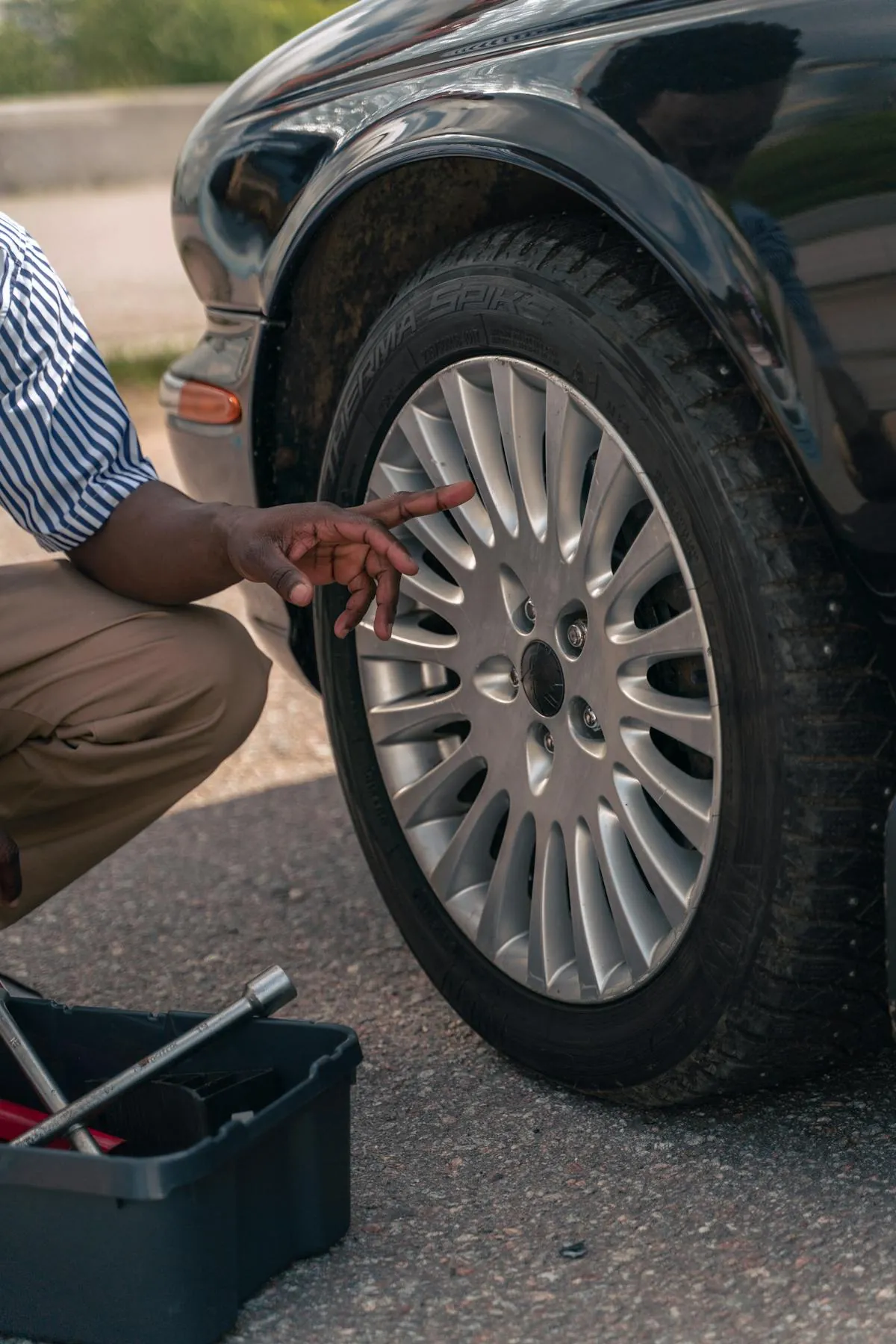
Tyres are a common reason cars fail their MOT, and almost every tyre failure is avoidable. The MOT tyre inspection covers tread depth, size and type, physical condition and the tyre pressure monitoring system (TPMS). A quick pre-check at home a week before the test can save you a failure, a retest and a wasted trip.
What the MOT checks on your tyres
The tester works through a defined list, set out in the MOT rules (GOV.UK). On your tyres, that means:
- Tread depth: at least 1.6mm across the central three-quarters, all the way round.
- Condition: no deep cuts, bulges, lumps or cords showing. Any sidewall damage that reaches the cords, or any bulge, is a fail.
- Size and type: correct for the vehicle, and not mismatched across an axle.
- TPMS: on cars first used from 2012, a faulty tyre pressure warning light is a fail.
- Valve condition and secure, undamaged seating.
The faults that catch people out
Uneven wear is the big one. A tyre can read fine in the middle but be bald on an inner edge you can't easily see, usually due to poor alignment. Mixing radial and cross-ply tyres, or fitting different sizes on the same axle, will also fail. So will a tyre that's the wrong speed or load rating for the car. None of these are obvious unless you look, which is why a tyre that "seems fine" still fails surprisingly often.
How to pass first time
A week before your MOT, do the 20p test on all four tyres, including the hidden inner edges, check pressures against the figure in your door sill, and look for cracks or bulges. If anything is marginal, replace it before the test rather than after, when you can't legally drive on it anyway. Doing it a week ahead leaves time to get any borderline tyre changed without the pressure of a failed test and a booked retest.
What happens if you fail
If a tyre is the reason for a fail, you can't legally drive on it once the old MOT has expired, and a tyre below 1.6mm or with a dangerous defect is illegal regardless. That means the safe route is to have the tyre replaced where the car is, rather than driving it to a tyre shop. A fail also means a retest, which is usually free or reduced if done within a set window at the same garage, so getting the tyre sorted quickly keeps the retest simple. The key point is not to drive away on a tyre that failed for being illegal.
Pre-MOT tyre checklist
Work through this the weekend before the test; it takes ten minutes and covers everything the tester will look at on the tyres.
| Check | How | Passes if |
|---|---|---|
| Tread depth | 20p in the main grooves at inner, centre and outer, at several points round the tyre | Outer band of the coin hidden everywhere in the central three-quarters (1.6mm) |
| Inner edges | Turn the steering to full lock each way and look at the inside shoulder of each front tyre; use a torch for the rears | No bald strip or cord |
| Sidewalls | Run a hand round both sides of each tyre | No bulges, deep cuts, cracks or cord |
| Size and rating | Compare the sidewall markings with the door placard or handbook | Correct size, load and speed rating; same size and construction on each axle |
| Pressures | Gauge, tyres cold | At the placard figure; not gauged, but an obviously under-inflated tyre is recorded as a minor defect |
| TPMS | Turn the ignition on and watch the warning light | Light comes on, then goes out (cars first used from 2012) |
| Valves | Look, and wiggle gently | Not cracked, not leaking, cap present |
| Objects in the tread | Look for nails and screws | None; if found, have it checked before the test |
The spare wheel is not part of the MOT, but while you are there, check it anyway; a flat space-saver is no use on the day you need it.
Dangerous, major, minor: how tyre defects are graded
Since 2018 MOT defects have been graded, and the grade tells you whether you can drive the car away.
- Dangerous. A direct and immediate risk. On tyres this covers tread below the legal limit, a lump, bulge or tear caused by the tyre's structure separating, exposed or damaged cords, and a tyre whose load capacity is too low for the axle. The car fails, and GOV.UK is clear that a vehicle with a dangerous defect should not be driven until it is repaired.
- Major. A fail that affects safety or the environment. A cut deep enough to reach the ply or cords, a load or speed rating below the minimum, different sizes or structures on the same axle, and a tyre pressure monitoring system that is malfunctioning sit here.
- Minor. Recorded but not a fail, for example an obviously under-inflated tyre.
- Advisory. Not a defect yet, but the tester wants you to know: tread getting close to the limit, slight cracking, uneven wear. Advisories are printed on the certificate and stay on the online record.
The practical difference matters on the day. If the old certificate is still in date, a car that fails on a major defect can be driven to have it fixed or to a booked retest, provided it meets the minimum standard of roadworthiness at all times, which a tyre below 1.6mm does not. A car with a dangerous defect should not be driven at all. Either way, driving on a tyre below the legal limit risks up to £2,500 and 3 points per tyre regardless of the MOT, see illegal tyre fines and penalty points.
Tyre age, cracking and the MOT
For cars there is no age limit on tyres at the MOT, but cracking and perishing are inspected, and old tyres fail on those.
The ten-year tyre age rule that came in from February 2021 applies to the front axles of lorries, buses, coaches and minibuses, not to ordinary cars and vans. A car tyre is judged on its condition. That said, rubber hardens and cracks with age, and a tester who finds cracking deep enough to expose the cords, or cracks running around the sidewall, will fail it. Fine surface crazing is usually an advisory rather than a fail.
If your tyres are more than six or seven years old, check the sidewalls closely before the test, especially on a car that stands outside or a vehicle that does low mileage. The four-digit date code tells you the week and year of manufacture, and our guide to when a tyre is too old explains how to read it.
Tyre age is one of the things a tester cannot see from a distance but will find with a torch, so it is a common source of surprise advisories on otherwise well-kept cars.
What to do with a tyre advisory
An advisory is a pass with a warning: the tyre is legal today, but it will not be for long. The most common ones are tread close to the limit, uneven wear, and slight cracking or perishing.
The right response depends on the wording. "Tyre worn close to legal limit" on a tyre at around 2mm means you have perhaps a few thousand miles, less in a wet winter when shallow tread struggles to clear water. Plan the replacement now, and if it is one of a pair, budget for both. "Tyre wearing unevenly" means the tyre is a symptom; get the alignment checked before new rubber goes on, or the new set follows the old one. "Slight cracking" means check the age and keep an eye on it.
Advisories also stay on the vehicle's public MOT history, which anyone buying the car can look up. A string of tyre advisories year after year says something about how the car has been looked after, so clearing them promptly protects the car's value as well as your safety. If you want the tyre sorted without a garage trip, a mobile fitter can replace it at home or work and check the others at the same time.
Failing on tyres? We'll come to you
If your tyres won't pass, our mobile tyre fitting service brings replacements to your home or workplace, so you can retest without driving on illegal rubber. Book a slot online or by phone.
