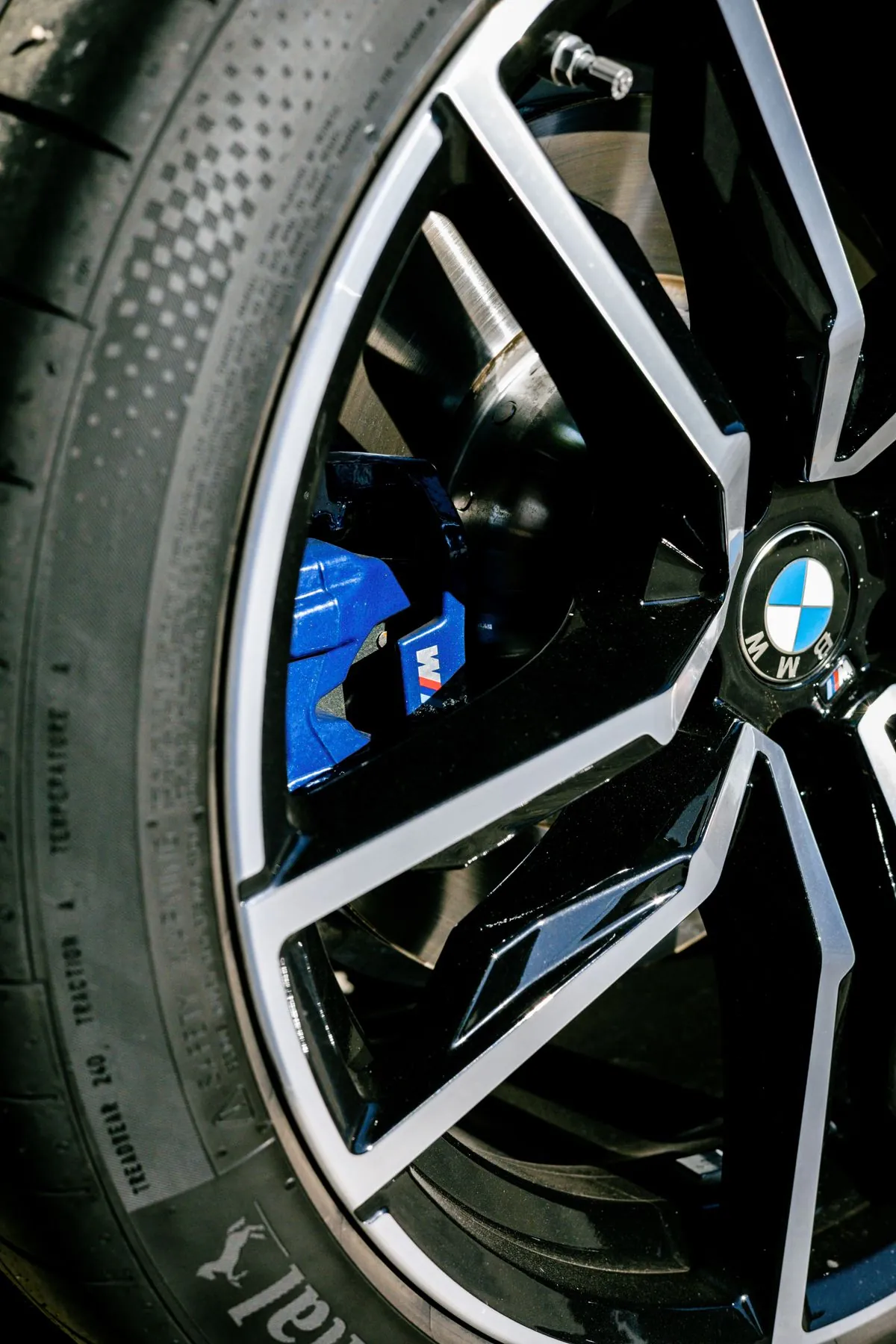
Driving on an illegal tyre carries a penalty of up to £2,500 and 3 penalty points, per tyre. That means four bad tyres could in theory cost £10,000 and 12 points, enough for a ban if the court counts each tyre separately. It can also put your insurance claim at risk if you're involved in a collision. The tyre rules are summarised in the Highway Code on GOV.UK; the offence is in section 41A of the Road Traffic Act 1988, and the fine and points are set by the Road Traffic Offenders Act 1988. Each defective tyre is a separate offence.
What makes a tyre illegal?
A tyre doesn't have to be bald to be illegal. Any one of these is enough to land you a fine and points:
- Tread below the legal 1.6mm minimum anywhere in the central three-quarters.
- Cuts longer than 25mm or 10% of the section width, whichever is greater, and deep enough to reach the ply or cord.
- Lumps, bulges or cord visible through the rubber.
- An under- or over-inflated tyre that's clearly unfit for use.
- The wrong size, construction or speed/load rating for the vehicle.
Why the penalties are per tyre
The law treats each defective tyre as a separate offence, which is why the costs multiply so quickly. Two bald tyres is two offences, not one. With all four illegal you're looking at a theoretical £10,000, and 12 points if the court counts each tyre separately, which would be enough for a ban. Beyond the money, the bigger risk is safety: worn tyres dramatically increase stopping distances in the wet, which is the real reason the limit exists. The penalties are designed to make the legal minimum a floor you don't go near, not a target.
Insurance implications
If you have an accident on tyres that were illegal, your insurer may reduce or refuse a payout, arguing the vehicle wasn't roadworthy at the time. That financial exposure usually dwarfs the cost of new tyres, and it can apply even if the tyres weren't the direct cause of the crash. In practice, a set of illegal tyres turns a claim into an argument you may well lose, on top of the fine and points, so the saving from putting off new tyres is a false economy.
How tyres get checked
Defective tyres are a routine finding at the roadside and in the MOT. Police can stop a vehicle and issue penalties on the spot, and the MOT inspects tread, condition, size and the TPMS every year. The catch is that a tyre can pass a casual glance but be illegal on an inner edge you can't easily see, usually from poor alignment. That's why a proper monthly check, including the inner shoulders, is worth the two minutes it takes.
What happens at a roadside stop
If the police stop you and find a defective tyre, they can deal with it on the spot or send it to court, and the outcome depends on how bad the tyre is and how many are affected. An officer will usually check tread depth with a gauge across the central three-quarters, then look at the sidewalls for cuts, bulges and exposed cord, and check that the size and type match the vehicle.
The possible outcomes, broadly:
- A fixed penalty with points, for a single marginal tyre.
- A vehicle defect rectification notice in some cases, which gives you a short period to fix the defect and show proof, in place of a penalty. Not every force offers it and it is at the officer's discretion.
- Prosecution for serious or multiple defects, where the court can impose up to £2,500 and 3 points for each tyre.
- A prohibition on driving the vehicle until the tyre is replaced, if it is dangerous. You then need a fitter to come to it, which is where a mobile tyre fitting visit is the practical answer.
DVSA examiners carry out the same checks on commercial vehicles at roadside checkpoints. Whatever the outcome, the officer decides based on what the tyre looks like at that moment, so "I was going to get it done next week" does not help.
New drivers and the six-point rule
For a driver who passed their test less than two years ago, two illegal tyres can mean losing the licence altogether. Under the New Drivers Act, reaching six or more penalty points within two years of passing means the licence is revoked, and you go back to a provisional, retake the theory test and the practical test, and start the two-year period again. When several tyre offences come from the same stop, the court normally endorses the points for one offence only, unless it decides otherwise and gives its reasons (Road Traffic Offenders Act 1988, section 28). The figures below are the worst case.
Because tyre offences carry three points each, the arithmetic is unforgiving:
| Illegal tyres found | Points if each tyre is counted | New driver (under 2 years) | Experienced driver |
|---|---|---|---|
| One | 3 | Three points on a clean licence | Three points |
| Two | 6 | Licence revoked | Six points, half way to a totting-up ban |
| Four | 12 | Licence revoked | Totting-up disqualification |
Points from tyre offences also count towards the twelve-point totting-up threshold for everyone else, and they stay relevant for insurance quotes for years. New drivers often run older cars on the cheapest tyres, which is exactly the combination that leads to worn inner edges nobody has noticed. Our new driver tyre guide covers what to check and how often.
Checking each defect yourself
Every defect that makes a tyre illegal can be spotted on the driveway with a 20p coin, a torch and two minutes per wheel. Turn the steering to full lock so you can see the inner shoulders of the front tyres, and use the torch on the rears.
| Defect | The legal test | How to check |
|---|---|---|
| Worn tread | Below 1.6mm anywhere in the central three-quarters, around the full circumference | The 20p test in several grooves, inner, centre and outer, at three points round the tyre |
| Cut | Longer than 25mm or 10% of the section width, whichever is greater, and deep enough to reach the ply or cord | Run a gloved hand round both sidewalls feeling for a lip |
| Bulge or lump | Any, caused by structural failure | Look at the sidewall side-on; a bulge stands proud of the surface |
| Exposed cord | Any ply or cord visible | Look for white or metallic threads, often on a worn inner edge |
| Wrong tyre | Size, load or speed rating below the vehicle's requirement, or mixed construction across an axle | Compare the sidewall markings with the door placard |
| Pressure | Inflated so as to be unfit for use | Check with a gauge against the placard |
Tread wear indicators, the small raised bars in the grooves, sit at 1.6mm: if the tread is level with them, the tyre is at the limit. Wet grip drops off well before that, which is why we suggest planning a replacement from about 3mm, see when to replace tyres.
Vans, taxis and trailers
The same defects and the same per-tyre penalties apply to vans, taxis, motorhomes and the trailer or caravan behind you. A few things change with the vehicle:
- Trailers and caravans are checked as part of the combination, so a bald trailer tyre is your offence as the driver. These tyres age rather than wear, so check the date code and the sidewalls for cracking.
- Vans carry heavy loads on commercial-rated tyres, and an under-rated tyre, one without the load index the van needs, is itself a defect.
- Taxis and private hire face the council's licensing inspection as well as the police, and a tyre defect can take the vehicle off the road until fixed.
- Company vehicles put the employer in the frame too: an employer who allows a vehicle to be used with a known defect can be prosecuted alongside the driver, which is why fleets run tread checks on a schedule.
The spare is not counted unless it is on the car and in use, but a space-saver must be used within its own markings, including the speed limit printed on it.
Stay legal without the hassle
Check your tyres monthly with the quick 20p test and replace anything marginal before it becomes illegal. If you'd rather not drive to a garage on a doubtful tyre, our mobile fitters come to homes and workplaces from our one base at Brent Cross, NW2, including evenings and weekends when the diary allows. London and the Home Counties are closest; further out, call and we will tell you whether we can take the job.
