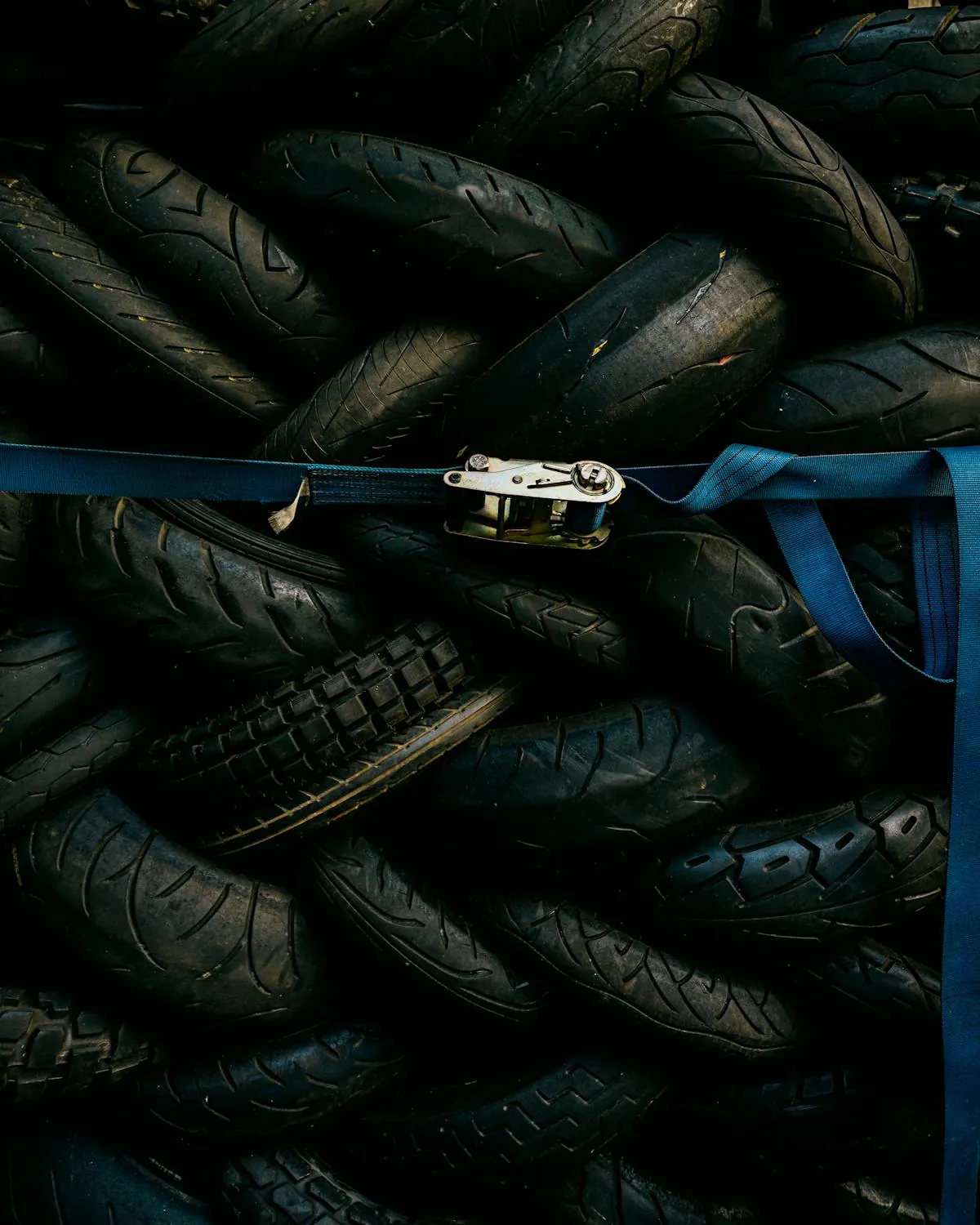
Replace your tyres when the tread approaches 3mm, when the rubber is cracked or bulging, or when older tyres show their age. You don't have to wait for the legal 1.6mm limit, because by then wet braking is already badly compromised. Here are the seven clear signs it's time for a fresh set.
1. Low tread depth
Use the quick 20p test. At or near 1.6mm the tyre is at the legal edge, but most fitters and TyreSafe recommend changing at around 3mm, because wet grip falls off sharply below that. Tread is what clears water and stops you in the rain, so low tread is the most safety-critical sign of all.
2. Cracks in the sidewall
Fine cracking, known as "crazing", means the rubber is perishing, often with age or sun exposure. It weakens the tyre even when the tread still looks fine, so it shouldn't be ignored, particularly on low-mileage cars where the tread lasts for years.
3. Bulges or blisters
A bulge is a failed internal structure, usually from a pothole or kerb impact. It's an immediate replacement and is illegal to drive on, because it can let go without warning at speed. Don't wait, replace a bulging tyre straight away.
4. Vibration or a pull
Vibration can mean a buckled wheel or a balance problem, while a pull often signals alignment trouble or uneven wear. Both shorten tyre life and are worth investigating early, because the underlying fault will keep eating the tread until it's fixed.
5. Repeated punctures
If a tyre keeps going down, the structure may be compromised. Sometimes another repair isn't safe or permitted, especially if the punctures are close together or outside the safe zone, and replacement is the sensible call rather than patching it again.
6. Age over five years
Check the DOT date on the sidewall. Rubber degrades over time regardless of use, and many manufacturers advise a yearly check from five years and replacement at ten years at the latest, even if there's tread left, especially on low-mileage cars, caravans and the spare, which can be far older than you think.
7. Uneven wear patterns
Bald shoulders or a worn centre strip tell you pressures or alignment are off. Fix the cause first, then fit fresh tyres, so the new ones don't wear out the same way. Reading the wear pattern often points straight to the underlying problem. As a rule of thumb, treat any one of these seven signs as a reason to get the tyre looked at, and treat two or more together as a clear case for replacement. A tyre is the only thing connecting your car to the road, so when in doubt, it's the part least worth gambling on.
What the law and the MOT require
The legal minimum in the UK is 1.6mm of tread across the central three-quarters of the tyre's width and around its whole circumference, and it applies to every tyre on the car, including the one you cannot see on the inside edge.
Drive below it and you can be fined up to £2,500 and given three penalty points for each tyre, which on a set of four is enough to lose a licence. The rules are set out on GOV.UK.
The MOT looks at more than tread. The tester checks for cuts, bulges, exposed cords and other damage, that the tyre is the right size and rating for the car, and that the two tyres on an axle are of the same construction, so a radial cannot be paired with a cross-ply.
Tyres close to the limit are recorded as an advisory rather than a failure, which is a warning, not a pass mark. Our guide to tread depth law goes into the fine print.
Two things the MOT does not do: it does not measure tyre age, so a ten-year-old tyre with good tread passes; and it happens once a year, while a tyre can go from legal to illegal in a couple of months of hard use. Treat the certificate as a snapshot, not a guarantee.
Replace one, two or all four?
Replace in pairs across an axle wherever you can, and put the new pair on the rear. That is the short answer, and it holds even on a front-wheel-drive car.
The reasoning is about balance. Two tyres on the same axle with very different tread depths grip differently in the wet, and the car can behave unpredictably under braking or in a bend.
Fitting the fresher pair to the rear keeps the back of the car planted; a rear that lets go before the front produces a spin, which is far harder to catch than the understeer you get when the front runs wide. Tyre makers and safety bodies have advised this for years.
| Situation | Sensible approach |
|---|---|
| One tyre damaged, the other on the axle nearly new | Replace the one, matching brand and pattern if possible |
| One tyre damaged, the other half worn or more | Replace the pair |
| Front pair worn, rears still good | Fit the new pair to the rear, move the rears forward |
| All four at 3mm or below | Replace the set |
| Four-wheel drive with a tight tolerance in the handbook | Follow the handbook; some systems need all four within a set difference |
Our guide to replacing tyres in pairs goes through the exceptions.
A monthly five-minute check
Most of the seven signs above can be caught early with a routine that takes less time than filling the tank. Do it monthly and before any long trip, when the tyres are cold.
- Pressures. All four against the placard in the door shut, plus the spare if you have one. A tyre that needs topping up every month has a slow leak worth finding.
- Tread. The 20p test at the inner edge, centre and outer edge of each tyre. Turn the steering to full lock to see the inside shoulders of the fronts.
- Sidewalls. A hand run round each one, feeling for bulges, cuts and cracking, and a look at the inner sidewall with a torch.
- Objects. Nails, screws and stones in the tread. A screw that is not leaking yet will be.
- Date. Once a year, read the four-digit code on the sidewall and note how old each tyre is.
- Valves. A cracked rubber valve or a missing cap is a leak waiting to happen.
Write the readings down, on the phone or in the handbook. Two sets of numbers a few months apart tell you the wear rate, and the wear rate tells you when to book the change rather than being surprised by it.
The cost of a gauge and a torch is trivial against a wet-weather stop that ends a car length short.
Spotted any of these? Our mobile tyre fitting service replaces tyres at your home or work, from our only base at Brent Cross, NW2. Further away, call and we will tell you whether we can take the job.
