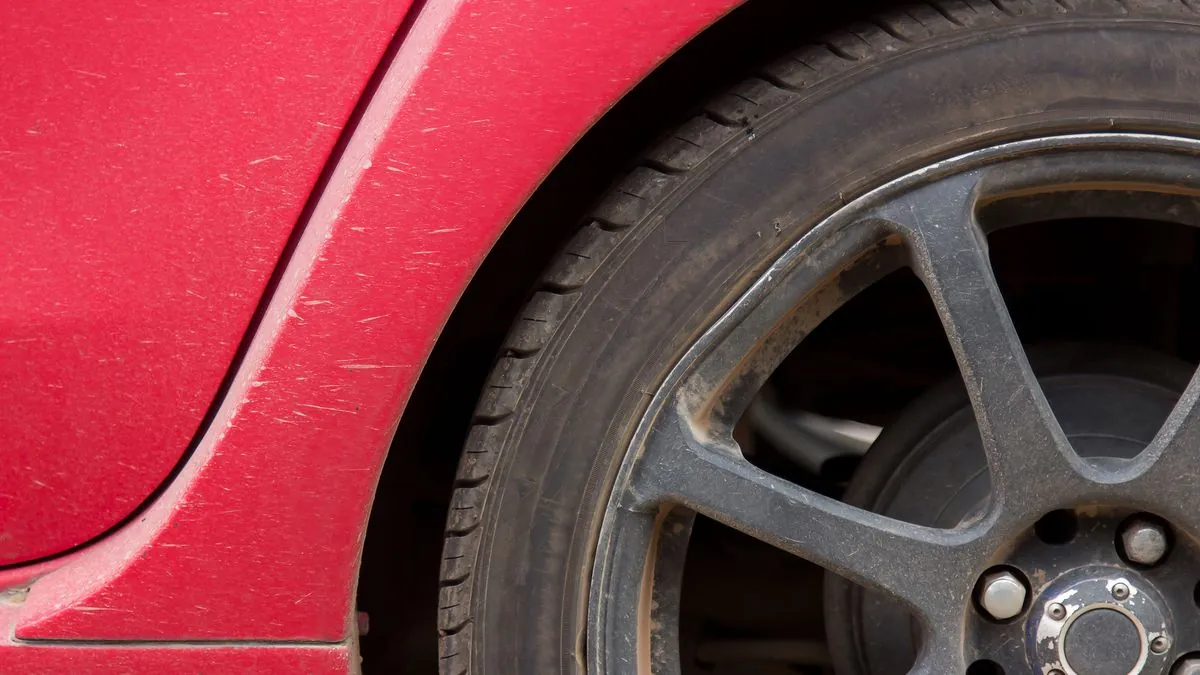
You don't legally have to replace tyres in pairs, but keeping the two tyres on an axle matched matters for safe, balanced handling. And when you do fit just two new tyres, there's a clear safety reason they generally go on the rear. Here's the rule, simply explained, so you balance cost against safety the right way.
The short answer
It's fine to replace a single damaged tyre if the others have plenty of tread, see one tyre or all four. But if you're replacing two, do them as an axle pair, both fronts or both rears, so grip is even side-to-side. What you want to avoid is two very different tyres on the same axle, which makes the car behave unevenly.
Why axle pairs matter
The two tyres on an axle share the work of braking, cornering and gripping. If one is fresh and grippy and the other is worn, the axle grips unevenly, which can make the car pull or feel unpredictable under braking, especially in the wet. Matching them keeps the handling balanced and predictable, which is the whole point.
Why new tyres go on the rear
When you fit two new tyres, the standard industry safety advice is to put them on the rear axle, even on a front-wheel-drive car. The deeper tread clears water better and keeps the back of the car planted (TyreSafe), so it's far less likely to slide round (oversteer) in a wet corner or an emergency stop. A car that understeers gently at the front is much easier to control than one that snaps at the rear.
When a single tyre is fine
If only one tyre is damaged and its axle partner still has plenty of even tread, replacing the single tyre is perfectly fine, as long as the new one matches the size and ratings. The pair rule is about not mixing very different tyres on an axle, not about always buying two. All-wheel-drive cars are a separate case and may need all four.
How closely must an axle pair match?
The two tyres on an axle must be the same size and construction by law, and should be the same make, pattern and roughly the same tread depth for the car to handle properly. There is a legal minimum and a sensible standard, and they are not the same thing.
| Across one axle | Requirement |
|---|---|
| Size (e.g. 205/55 R16) | Must match; different sizes on an axle can fail the MOT |
| Construction (radial vs cross-ply) | Must not be mixed on the same axle by law |
| Load index and speed rating | Must meet the car's specification; ideally identical |
| Make and tread pattern | Not a legal requirement, but strongly advised |
| Tread depth | No legal figure; keep the difference small |
| Summer, winter or all-season type | Not law, but never mix types on an axle |
The construction rule is regulation 26 of the Road Vehicles (Construction and Use) Regulations 1986. Almost every modern car tyre is radial, so it rarely bites, but it is the reason the sidewall carries that R.
Tread depth is where judgement comes in. A new tyre at 8mm alongside a partner at 3mm will grip differently in the wet, and the car will feel it under hard braking.
A common workshop rule of thumb is to keep the pair within a couple of millimetres of each other; if the partner is close to the legal limit anyway, replace both and be done with it.
Four-wheel drive and electric cars
On many four-wheel-drive cars you should replace all four tyres together, or at least check the handbook before fitting two. The centre differential or coupling on a permanent or on-demand 4x4 measures the difference in rotation between the front and rear axles.
Tyres of different tread depths roll at slightly different speeds, and the system can read that as constant slip, heating the coupling and in some cases damaging it.
Manufacturers deal with this in different ways. Some specify that all four tyres must be within a stated tread-depth difference; some require a single new tyre to be shaved to match; some are relaxed about it. The only safe answer is the one in your handbook, and a fitter who is not sure should say so rather than guess.
Our guide to tyres for SUVs and 4x4s covers the wider choice.
Electric cars raise a different issue. They are heavy and deliver torque instantly, so they wear tyres faster and often unevenly between axles, and many are fitted with tyres that carry a manufacturer-specific marking or a higher load rating.
When you replace two on an EV, match the marking and the load index exactly, and fit the new pair to the rear for the same stability reasons as any other car.
Rotating an EV's tyres front to rear more often than on a petrol car is the simplest way to keep the four close enough to replace as a set.
How to avoid buying odd pairs at all
If your tyres wear evenly, you replace them as a set of four and the pairing question never comes up. Odd pairs are usually the result of the fronts wearing out long before the rears, or one tyre being ruined by a kerb or a pothole.
- Rotate front to rear at service time if your tyres are the same size all round and not directional in a way that prevents it, see tyre rotation guide. On a front-wheel-drive car the fronts handle steering, braking and drive, and wear roughly twice as fast.
- Keep pressures right. A tyre run soft wears its shoulders and can be scrap while its partner is fine.
- Fix alignment promptly. A car that pulls, or a tyre feathered on one edge, will destroy that tyre well ahead of the others.
- Repair, do not replace, when you can. A nail in the central tread is a repair, which keeps the pair matched. Only sidewall or shoulder damage forces a single new tyre.
If you do end up with one damaged tyre and three good ones, ask about the same make and pattern before accepting whatever the fitter has to hand. It can usually be ordered in, and a matched axle is worth the short wait if the car is still driveable on the spare.
What a good fitter does with two new tyres
When you buy two tyres, the fitter should look at all four, put the best pair on the rear, and hand the car back balanced, torqued and at the right pressures. That means more work than simply swapping the two you paid for, and it is worth knowing what to expect so you can ask for it.
- Measure all four. Tread depth in three places across each tyre, plus a look at the DOT date and the sidewalls. Sometimes this changes the decision: if a "good" rear turns out to be six years old and cracking, two new tyres becomes four.
- Fit the new pair to the rear. If the worn tyres were on the front, that means moving the old rears forward, which is extra time on the job. A fitter who skips this to save ten minutes is leaving you with less stable handling.
- New valves, balance, torque. Every new tyre gets a new valve or TPMS seal, is balanced on a machine, and the wheel nuts are torqued to the car's figure, not left to an impact gun.
- Set all four pressures to the placard figure, not just the new ones.
Our guide to what a tyre fitter checks goes through the full inspection. The whole thing is routine on a driveway with a mobile fitter; you should not have to accept less because the work is done at home rather than in a garage.
We fit it right
We'll fit the right number of tyres and put them in the correct position for safe handling, at your home or work from our one base at Brent Cross, NW2. If you are further out, call and we will tell you whether we can take the job; the arrival time is given on the call.
