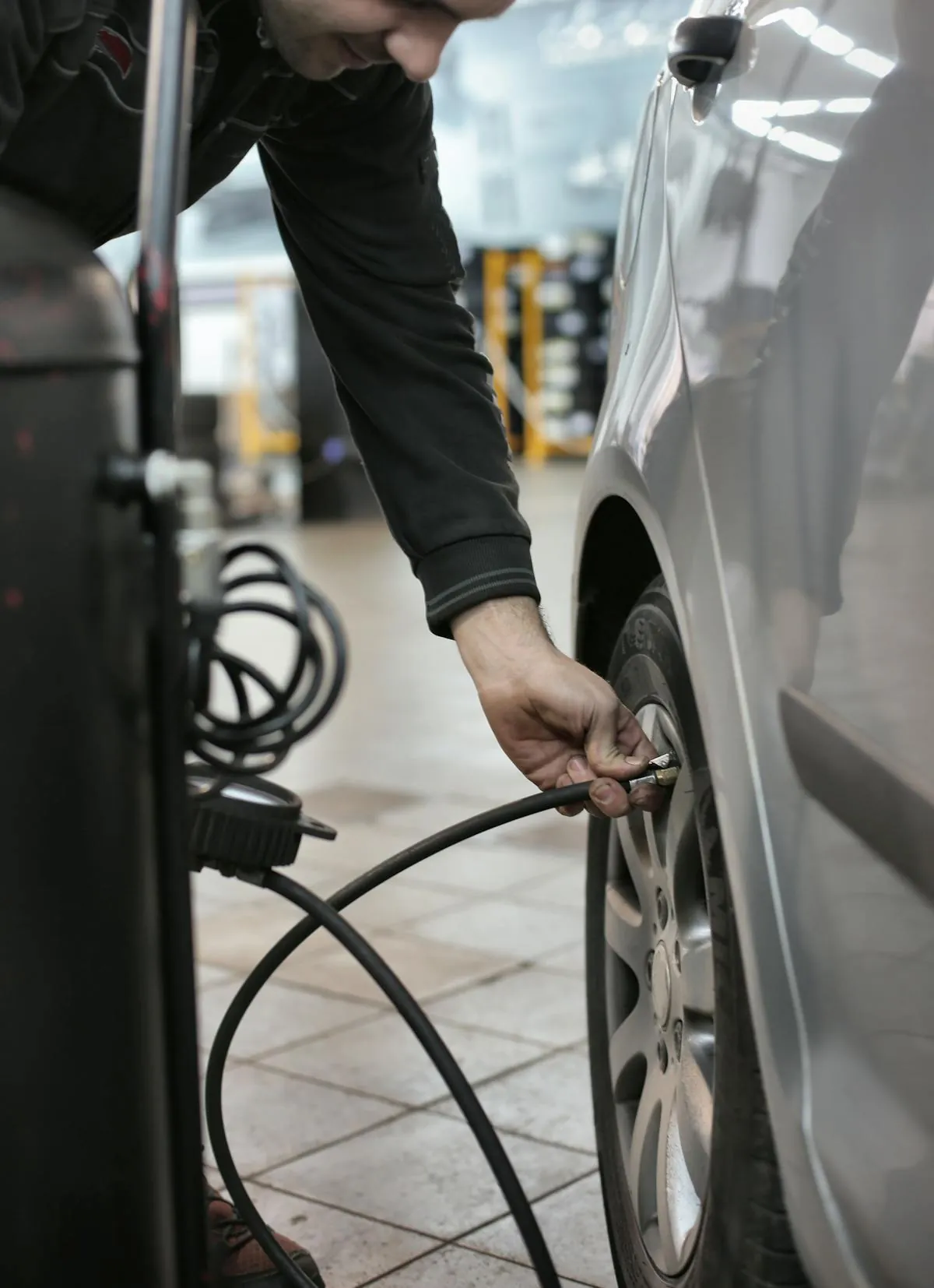
The correct tyre pressure for your car is the figure the vehicle manufacturer gives in the handbook, inside the fuel filler flap or on the driver's door sill. That's where TyreSafe tells drivers to look (TyreSafe). Set the tyres to that figure when they're cold, and use the higher "full load" figure when the car is loaded up.
Getting it wrong matters most on the low side. The Highway Code says plainly that "your brakes and steering will be adversely affected by under-inflated or over-inflated tyres" (Highway Code, Annex 6). This guide covers where to find your figure, what under-inflated tyres do to a car, the signs to look for, how to check and correct the pressure, and a PSI and bar table for converting the units.
Where to find your correct tyre pressure
Look in three places: the handbook, the inside of the fuel filler flap and the driver's door sill or pillar. The figure is specific to your model and tyre size.
- Driver's door sill or pillar. Usually a sticker you can see when the door is open.
- Fuel filler flap. Common on many cars.
- Handbook. The full table, including every wheel size the car was sold with.
The AA notes that there are usually two figures: one for normal use and a higher one for full loads (AA). If the car was offered with more than one wheel size, read the row that matches the tyre size actually fitted; the size is moulded on the sidewall. The pressure moulded on the tyre itself is not your car's recommended figure, so don't set your tyres to it.
How would under-inflated tyres affect your vehicle?
Under-inflated tyres make a car brake, steer and handle worse, wear out faster, use more fuel and are more likely to fail suddenly. The Highway Code gives the core answer: brakes and steering "will be adversely affected". The tyre industry and motoring organisations add the detail:
| Effect | What happens | Source |
|---|---|---|
| Braking | "Under inflated tyres will increase stopping distances and affect your vehicle's handling" | AA |
| Steering and handling | Brakes and steering "will be adversely affected"; handling and grip worsen, with "potentially... unpredictable vehicle behaviour" | Highway Code, TyreSafe |
| Heat and blowouts | Tyres "flex more and get hotter, making sudden tyre failure (blowouts) more likely" | AA |
| Tyre wear | "Premature wear on the outside edges of the tyre" | TyreSafe |
| Fuel and range | Increased rolling resistance means "more fuel is needed to turn your wheels" | RAC |
| Damage | More susceptible to impact damage, and more prone to punctures | TyreSafe, RAC |
| Wet grip | A properly inflated tyre gives "less likelihood of aquaplaning" | TyreSafe |
The heat point is the one that turns a maintenance job into a safety problem. A soft tyre flexes more with every turn of the wheel, and that flexing heats the casing. On a long motorway run with a full car, that's how a tyre that looked fine in the morning fails in the afternoon.
Signs your tyres are under-inflated
The surest sign is a gauge reading below your car's figure, because a tyre can be noticeably low before it looks it. The other clues, drawn from RAC and TyreSafe guidance, are:
- The tyre pressure warning light. Cars with a tyre pressure monitoring system (TPMS) warn you when pressure drops. For cars first used on or after 1 January 2012, a TPMS that is malfunctioning or obviously not working is a major defect at the MOT (MOT inspection manual, section 5). See TPMS warning light explained.
- A tyre that looks squat or misshapen compared with the others.
- Steering that pulls to one side when you relax your grip. Alignment and brakes can cause it too.
- Vibration through the steering wheel, especially at speed, or handling that feels vague.
- Wear on both outer edges of the tread, which TyreSafe links to under-inflation.
- Something stuck in the tread. A nail or screw is a common reason one tyre keeps going soft.
If one tyre keeps losing pressure between checks, don't keep topping it up. That's usually a slow puncture, a leaking valve or a bead leak, and our slow puncture guide explains each.
How to check and correct tyre pressure
Check with the tyres cold, compare with your car's figure, then add or release air until each tyre matches. The Highway Code says to check "before your journey, when tyres are cold", because "warm or hot tyres may give a misleading reading". Michelin counts a tyre as cold when the car has been driven less than 2km (Michelin).
- Find the right figure for your tyre size and load: normal, or full load.
- Remove the valve cap and press the gauge or airline firmly onto the valve.
- Read the pressure. Forecourt gauges vary, so a gauge of your own gives more consistent readings.
- Add air in short bursts if it's low, rechecking as you go. If it's high, press the valve pin briefly to let air out.
- Repeat on every tyre, including the spare if the car has one, then refit the valve caps.
- Reset the TPMS if your car asks you to after adjusting pressures; the handbook explains how.
How often? The Highway Code's advice is to "check weekly". TyreSafe recommends checking "at least once a month and before any long journey" (TyreSafe FAQs), and the AA suggests every couple of weeks. A weekly glance and a monthly gauge check covers all three. More on timing in how often to check tyre pressure, and cold snaps are covered in why tyre pressure drops in cold weather.
PSI and bar: tyre pressure conversion table
1 bar is exactly 100 kPa, and 1 PSI is 6.894757 kPa, so 1 bar is about 14.5 PSI. Those factors come from the US National Institute of Standards and Technology (NIST), and the RAC and AA use the same 14.5 figure. Placards on cars sold across Europe often show bar and kPa, while many UK gauges read PSI. For any other figure, use our tyre pressure converter.
| PSI | bar | kPa |
|---|---|---|
| 26 | 1.79 | 179 |
| 28 | 1.93 | 193 |
| 30 | 2.07 | 207 |
| 32 | 2.21 | 221 |
| 34 | 2.34 | 234 |
| 36 | 2.48 | 248 |
| 38 | 2.62 | 262 |
| 40 | 2.76 | 276 |
| 42 | 2.90 | 290 |
| 44 | 3.03 | 303 |
And the other way, for placards that show bar:
| bar | PSI | kPa |
|---|---|---|
| 2.0 | 29.0 | 200 |
| 2.2 | 31.9 | 220 |
| 2.3 | 33.4 | 230 |
| 2.4 | 34.8 | 240 |
| 2.5 | 36.3 | 250 |
| 2.6 | 37.7 | 260 |
| 2.7 | 39.2 | 270 |
| 2.8 | 40.6 | 280 |
| 3.0 | 43.5 | 300 |
Is 32, 35 or 40 PSI normal? Any of them can be right, for a different car. There's no universal number, so the only correct figure is the one for your car, tyre size and load. If front and rear figures differ, that's deliberate, because the axles carry different weights; set each axle to its own figure.
The full-load figure, heavy loads and towing
Use the higher figure whenever the car is carrying a full load of passengers and luggage, or towing. The AA's point about two figures, one normal and one for full loads, is the part many drivers skip.
A family car set to the everyday figure and then loaded for a holiday is, in effect, running under-inflated for that weight. That's exactly the flexing and heat the AA warns about, on the kind of long, hot motorway trip where it matters most. If you tow a caravan or trailer, the car's full-load figure applies, and the trailer's own tyres need checking against its handbook too.
Pressure and load work together. The load index on a tyre is the weight it can carry when properly inflated, so a soft tyre can't do the job its rating promises.
When the placard is missing or wrong
If there's no placard, use the handbook. If there's no handbook, contact the manufacturer or a dealer for your model and tyre size. Never guess from a "typical" number, because cars on similar tyre sizes can need quite different pressures.
The placard can also mislead if:
- The wheels aren't the original size. A previous owner may have fitted larger wheels. Find the figure for the size actually on the car.
- The tyres have a different load rating. Extra load (XL) tyres on a car that came on standard-load tyres may need a different pressure to carry the same weight. The tyre maker's fitment guidance is the reference.
- The vehicle has been converted, such as a van fitted out as a camper that now runs close to its maximum weight all the time. Use the full-load figure as your starting point.
Motorways, nitrogen and electric cars
Three questions come up often: whether to add air for the motorway, whether nitrogen is worth it, and why electric cars often run higher pressures.
Motorways. Use the normal figure for a lightly loaded car and the full-load figure when it's full, whatever the road. Tyres read higher once they're warm, which is expected. Don't let air out of hot tyres at the services; the reading would be misleading, as the Highway Code notes.
Nitrogen. Filling with nitrogen doesn't replace regular checks. Pressures still change with temperature and small leaks.
Electric cars. EVs are heavy, and many specify higher pressures than a similar petrol car. The same rolling resistance that costs a petrol car fuel costs an EV range, so set the placard figure exactly.
Tyre keeps losing pressure? We come to you
If a tyre won't hold its pressure, the cause needs finding rather than topping up every few days. Rescue Tyres is a mobile tyre service working from one base at Brent Cross, NW2; London and the Home Counties are closest, and for anywhere further out we tell you on the call whether we can take the job. We come to your home, work or a safe place off the road and deal with the tyre where the car is: a puncture repair to BS AU 159 if it's repairable, or a new tyre in your car's size if it isn't. Every tyre we fit or repair is inflated to your car's figure before we leave.
The price is confirmed on the call before any work, and we give you an arrival time when you call. Evenings, nights, weekends and bank holidays are covered when the diary allows, at the same price as a weekday job. Call or WhatsApp 07473 720871, or see mobile puncture repair.
Sources
- GOV.UK Highway Code, Annex 6: vehicle maintenance, safety and security
- TyreSafe, Tyre pressure
- TyreSafe, The checks
- TyreSafe, Tyre FAQs
- The AA, Tyre pressures
- RAC, Checking tyre pressure
- Michelin, How and when to check tyre pressure
- GOV.UK, MOT inspection manual, section 5: axles, wheels, tyres and suspension
- NIST, Guide for the Use of the SI: conversion factors
