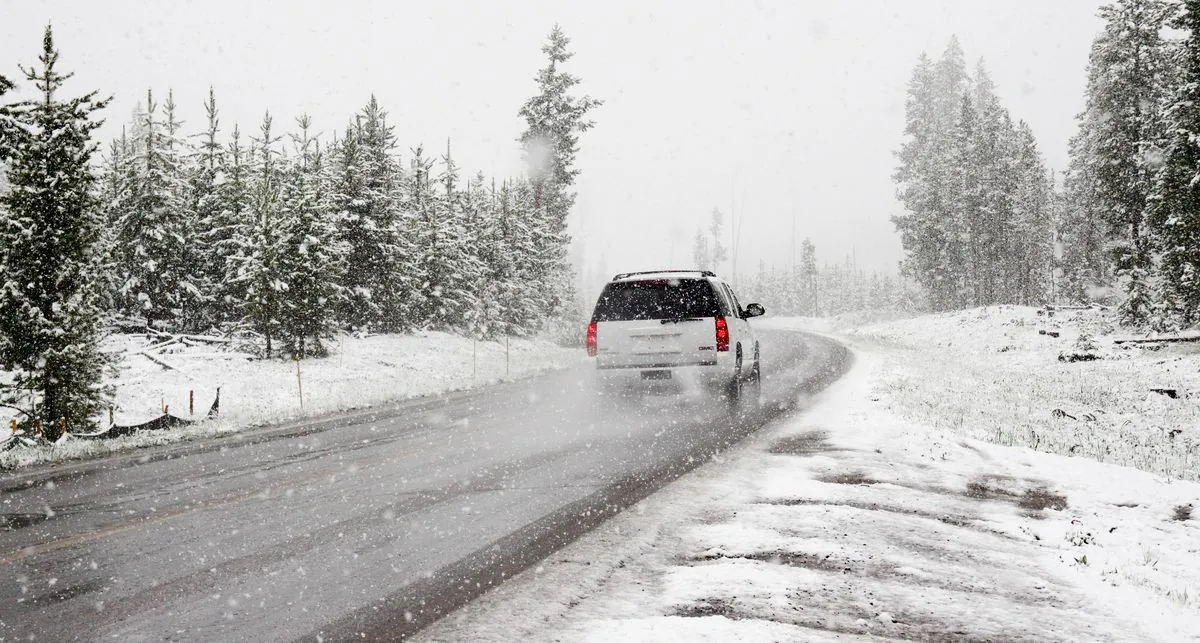
Cold weather makes the air in your tyres contract, so pressure drops, by about 1 PSI for every 5 to 6°C fall in temperature. That's why, when the pressures were already slightly low, a frosty morning can trigger the TPMS warning light even when there's no puncture at all. The fix is usually simple: top up to the correct pressure once you've ruled out a leak.
The science, briefly
Air pressure rises and falls with temperature. Park overnight in a sharp frost and the same tyre that read correctly in milder weather can read low by morning. It usually recovers a little as the tyre warms with driving, but if it's genuinely low against the recommended figure, it needs topping up rather than just waiting for it to warm. The effect is purely physical and happens to every tyre, which is why winter is the season the TPMS light appears most.
The reverse happens in a warm spell or after a long motorway run, when the tyre reads higher than its cold figure. That is normal too, and it is why the recommended pressure is always a cold pressure: it assumes the tyre has been standing for a few hours.
Cold snap or slow puncture?
A small uniform drop across all four tyres after a cold night is usually just temperature. One tyre that keeps going down is more likely a slow puncture. The simple test is to top all four up to the correct figure and watch over a week: if one tyre alone keeps dropping while the others hold, that's a leak rather than the weather, and it's worth getting checked before it lets you down on a cold morning.
How to set pressures in winter
The method matters as much in winter as any time:
- Check when tyres are cold, before driving or after only a mile or two.
- Use the recommended figure from the door sill or handbook.
- Don't over-inflate to silence a winter light, because that reduces grip on cold roads.
- Recheck after any big temperature swing, which winter brings plenty of.
TyreSafe recommends checking at least monthly, and winter is exactly when that habit pays off.
Why it matters more in winter
Correct pressure matters year-round, but the stakes are higher on cold, wet roads. An under-inflated tyre has a distorted contact patch, which cuts grip just when grip is scarcest, and it clears water less effectively, raising the risk of aquaplaning. Add the longer stopping distances that come with cold, wet tarmac, and a soft tyre in winter is a meaningfully bigger safety risk than the same tyre in summer. Keeping pressures spot-on is one of the cheapest things you can do for winter safety, alongside checking your tread and considering winter or all-season tyres.
What a cold night does to your pressures
Using the rough rule of about 1 PSI per 5 to 6°C, a tyre set correctly in mild autumn weather can be several PSI down by the first hard frost without losing a breath of air. The table shows what that looks like for a tyre set to 33 PSI at 15°C.
| Morning temperature | Change from 15°C | Approximate reading | What to do |
|---|---|---|---|
| 10°C | About 1 PSI down | 32 PSI | Top up if convenient |
| 5°C | About 1 to 2 PSI down | 31 to 32 PSI | Top up |
| 0°C | About 2 to 3 PSI down | 30 to 31 PSI | Top up; TPMS may warn if the tyres were already a little low |
| -5°C | About 3 PSI down | 29 to 30 PSI | Top up before driving far |
These are approximations, not a formula to set pressures by. The point is that the drop is big enough to matter, and that the fix is a gauge and an airline rather than a fitter. Check all four against the figure in your handbook or on the door sill, which our guide to correct tyre pressure explains how to read.
If a tyre reads much lower than the others after the same cold night, temperature is not the explanation. That is a leak, and it needs looking at.
Checking pressures at a forecourt in winter
The catch with a petrol-station airline is that you have driven to get there, and a driven tyre reads higher than a cold one. A few habits keep the reading honest.
- Use the nearest forecourt, ideally under two miles away, and go straight there. The shorter the drive, the closer the tyre is to its cold pressure.
- If the tyres are clearly warm, never let air out to hit the cold figure. You will end up under-inflated once they cool.
- Carry your own gauge. Forecourt gauges vary in accuracy, and a small digital gauge is cheap and consistent.
- Check the spare while you are there. It loses pressure sitting in the boot and nobody notices until it is needed.
- Put the valve caps back on. A missing cap lets water into the valve, and in a frost that can freeze and hold the core open.
Home compressors and 12V inflators that plug into the car make this easier, because you can check on the drive before the tyres have moved.
Does nitrogen help in the cold?
Not with the temperature effect. Nitrogen contracts in the cold in the same way as the air it replaces, so a nitrogen-filled tyre reads low on a frosty morning just like any other. The pressure drop described in this guide is physics that applies to every gas.
Where nitrogen has a modest case is in holding pressure between checks, because it is dry and seeps through the rubber slightly more slowly than air. That does not remove the need to check. Anyone who says nitrogen lets you ignore winter pressures is wrong; keep checking monthly. Our guide to nitrogen vs air weighs it up honestly.
The rest of the frosty morning check
Pressure is the quickest winter check, but it is not the only one, and the others take a minute. The Highway Code warns that stopping distances can be at least double in the wet and up to ten times greater on ice (GOV.UK), which is why the tyre's whole condition matters more in winter.
- Tread. Do the 20p test on all four. The legal minimum is 1.6mm across the central three-quarters, but grip on cold, wet roads falls away as the tread gets shallow.
- Sidewalls. Look for cracking, cuts or bulges, which cold rubber shows up more readily.
- Valves and caps. All caps present, no hissing at the valve.
- Snow or frost in the tread. Packed snow in the grooves hides the tread and can hide damage.
- The spare or the sealant kit. Inflated, in date and where you expect it to be.
If your area sees regular frost and you are still on summer tyres, now is the time to think about winter or all-season tyres, before the first slide.
Light won't go off?
If you've set the pressures correctly and the light persists, the tyre or a TPMS sensor may need attention, and sometimes a sensor battery fails in the cold. We can check the tyres for a leak where the car is parked in London and the Home Counties, and further out when the diary allows; ask on the call if you think a sensor is at fault.
