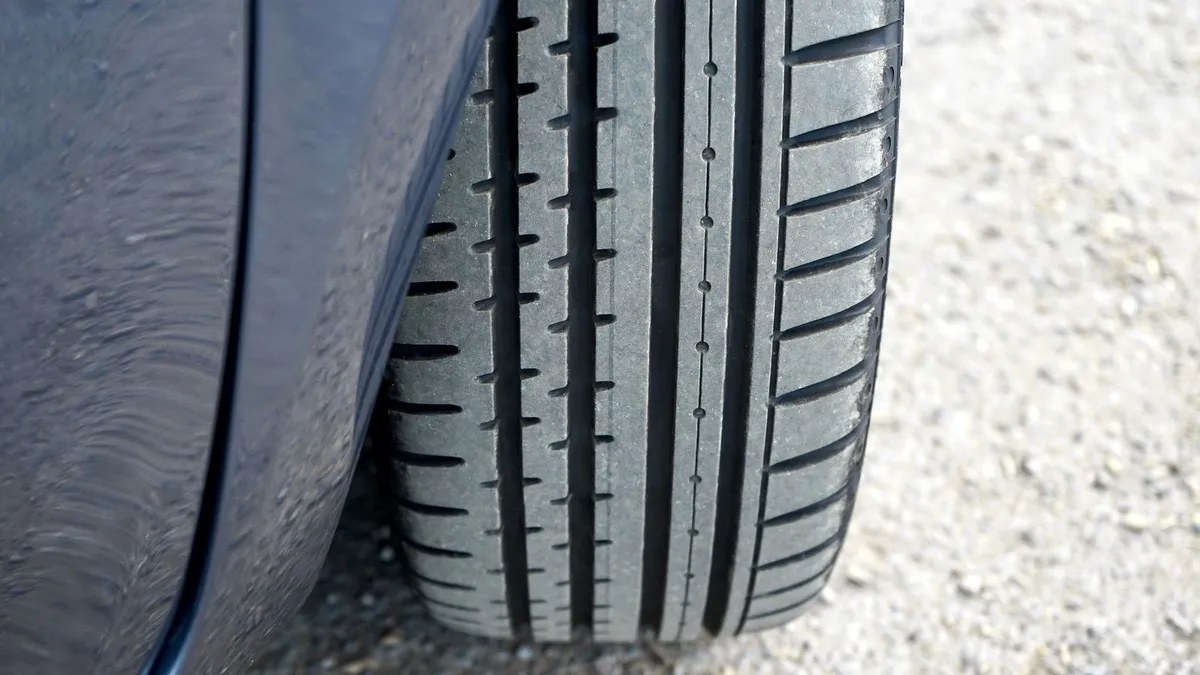
Wheel misalignment quietly destroys tyres and spoils handling. It happens gradually, or suddenly after a pothole or kerb strike, and it can wear a new tyre out in a few thousand miles. The frustrating part is that it often creeps up on you, so knowing the warning signs lets you catch it before it eats your tread. Here are the five to watch for.
1. The car pulls to one side
If you have to hold the wheel off-centre to drive straight on a level road, misalignment is a likely cause. Rule out the simple things first, though, because a low tyre or strong road camber can mimic the same pull. If pressures are correct and it still drifts on a flat, straight road, get the alignment checked.
2. Uneven or rapid tyre wear
Wear concentrated on one edge of a tyre is a classic alignment symptom, and it's one of the most expensive if ignored, because it can scrap an otherwise good tyre in a few thousand miles. See why tyres wear unevenly for the exact patterns to look for and what each one means.
3. An off-centre steering wheel
If the wheel sits crooked when you're actually driving straight, the alignment has shifted. This often shows up right after kerbing a wheel or hitting a pothole, which knocks the angles out in an instant.
4. Vibration through the wheel
Vibration can be alignment-related, though it's more often a balancing issue. The two are different jobs with different fixes, so it's worth having both checked if you feel a shake at certain speeds rather than guessing.
5. Squealing tyres
Tyres scrubbing across the road because of bad alignment can squeal, especially on slow turns and roundabouts. It's the sound of rubber being dragged sideways rather than rolling cleanly, which is exactly what wears it out.
What knocks alignment out
Most misalignment comes down to impacts and wear. Hitting a pothole or kerb at speed is the classic cause, knocking the angles out in an instant. Worn suspension and steering components let the angles drift over time, and even normal use gradually moves things off true. That's why it's worth a check after any heavy impact, and periodically as the car ages, rather than waiting for the tyres to show the damage.
Toe, camber and caster in plain English
Alignment is three angles per wheel, and each one leaves a different fingerprint on the tyre, which is how a fitter can often tell what is wrong before the car goes on the ramp.
| Angle | What it is | What it affects | Wear pattern when wrong |
|---|---|---|---|
| Toe | Whether the wheels point slightly in or out, seen from above | Straight-line tracking, steering response, tyre life | Feathered edges you can feel by running a hand across the tread; rapid wear on one edge |
| Camber | The tilt of the wheel in or out at the top, seen from the front | Cornering grip, pulling if unequal side to side | Smooth wear on the inside edge (negative) or outside edge (positive) |
| Caster | The fore-and-aft tilt of the steering axis, seen from the side | Stability at speed, self-centring of the steering, pulling if unequal | Little direct tyre wear, but a pull and heavier steering one way |
Toe is the angle that drifts most easily and causes the most tyre damage, because a wheel that is toed out scrubs sideways with every rotation. Even a small error, well under a degree, is enough to strip an edge over a few thousand miles.
Camber and caster are often set by the suspension design and are not adjustable on every car without aftermarket parts. If those angles are out on a car where they are fixed, something is bent or worn, and that needs finding before any adjustment is made.
Rule out the look-alikes first
Several cheaper problems mimic misalignment, so check these before booking an alignment, because they will not be fixed by one.
- Tyre pressures. A front tyre a few psi low pulls the car towards that side. Set all four cold to the placard figure and drive it again. See the correct tyre pressure guide.
- Road camber. UK roads slope towards the kerb for drainage, so a slight drift left on a single-carriageway is normal. Test on a flat, straight, level road or by noting whether the pull reverses on the other side of the road.
- A tyre pull. Tyres are not perfectly uniform, and one with a slight cone shape pulls to one side. Swapping the two front wheels side to side is the test: if the pull changes direction, it is the tyre, not the alignment. Note that directional tyres cannot simply be swapped across.
- A binding brake. A sticking caliper drags one wheel and pulls the car that way, often with a hot wheel and a smell after a drive.
- Mismatched tyres on an axle. Different makes, patterns or tread depths across the front axle can produce a pull on their own.
Our guide to why a car pulls to one side goes through these in order of likelihood. If everything above checks out and the pull remains, alignment is the next step.
Front tracking or four-wheel alignment?
A basic tracking check adjusts the front toe only; a four-wheel alignment measures all four wheels against each other and the car's centreline, and it is the one to ask for after a pothole or if the steering wheel sits off-centre.
Front tracking is cheaper and quicker, and it is enough for a car that has simply drifted a little with age. Its limitation is that it assumes the rear axle is straight. If the rear is out, the fronts get set to a thrust line that is itself crooked, and the car ends up tracking straight with the steering wheel slightly turned.
Four-wheel alignment reads the rear angles first, adjusts them where the car allows, then sets the fronts relative to the corrected rear. Choose it when:
- The car has hit a pothole or kerb hard enough to feel through the seat.
- The steering wheel is off-centre when driving straight.
- Rear tyres are wearing unevenly, which front tracking cannot address.
- The car has independent rear suspension with adjustable rear toe, which many modern cars have.
- You have just fitted a full set of new tyres and want them to last.
Ask for the printout. Reputable workshops show the readings before and after against the manufacturer's tolerance, in green and red, and that sheet is your record if you later need to claim pothole damage from a council.
Alignment and the MOT
The MOT does not measure wheel alignment, but it does fail the things bad alignment causes and the things that cause bad alignment, so it is not something the annual test lets you ignore.
What the tester looks at, per the DVSA inspection manual on GOV.UK:
- Tyre tread and condition. Alignment wear often strips one edge below the 1.6mm legal minimum while the rest of the tread looks fine. That is a fail, and it is also illegal to drive on, with a fine of up to £2,500 and three penalty points per tyre.
- Steering and suspension components. Worn track rod ends, ball joints, bushes and bearings are inspected for play, and excessive play fails the test. These same worn parts let the alignment drift.
- Steering operation. The tester checks that the steering moves freely and returns properly, which caster problems can affect.
The practical upshot is that a car with an alignment problem tends to arrive at its MOT with a tyre already on the edge, an advisory for uneven wear, or a worn joint that needs replacing before the angles can be set.
Dealing with the pull or the wear when you first notice it is cheaper than the combination of a new tyre, a part and an alignment at test time.
If you spot an edge wearing away, get the tread measured across its full width, not just the centre, because the legal check on tread is across the central three-quarters and the worn edge may be exactly where the problem is.
Why fix it promptly?
Misalignment wears tyres fast and increases fuel use, so it costs you twice. Tyre-safety charity TyreSafe highlights uneven wear as a key thing to check. Correcting alignment protects your new rubber and keeps the car tracking true. Alignment needs a workshop rig, so it is not a service we offer. If you've damaged a tyre on the same pothole, our broken tyre service can replace it where the car is parked in London and the Home Counties, and further out in the Midlands when the diary allows, from our one base at Brent Cross, NW2. We give you the arrival time when you call.
