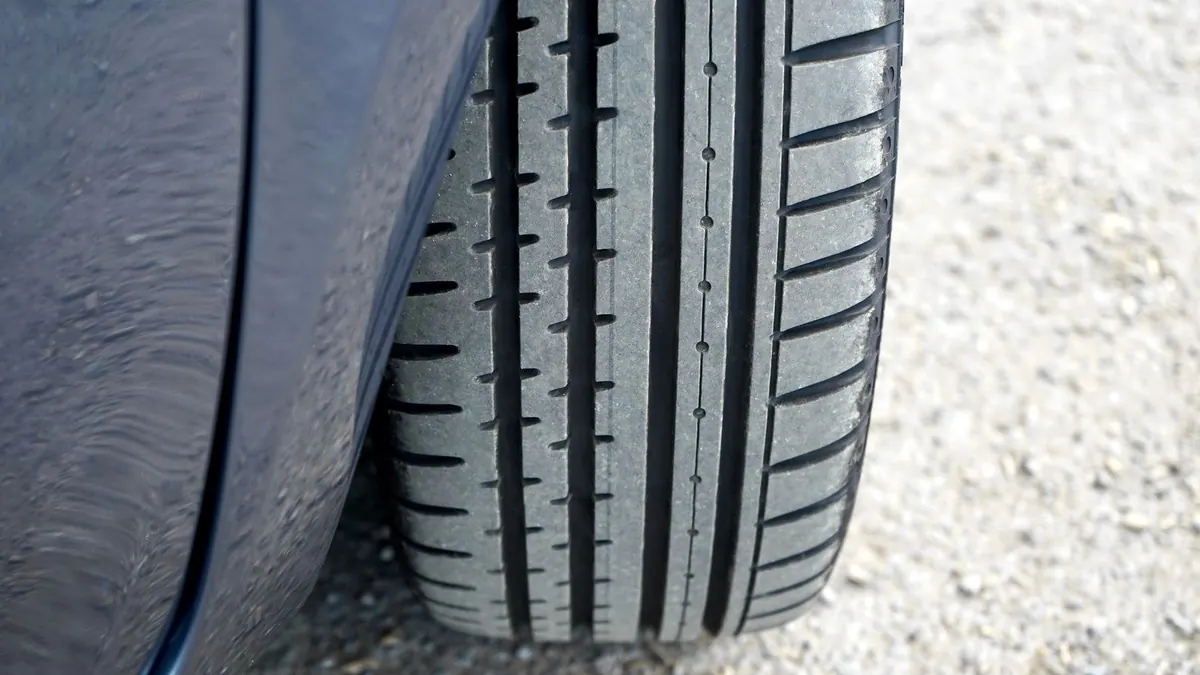
A self-sealing tyre is an ordinary tyre with a layer of sticky sealant bonded inside the tread area. Drive over a nail and the sealant flows around it; pull the nail out and the sealant closes the hole. It is a genuinely useful piece of engineering for the most common kind of puncture, and it is regularly confused with run-flat technology, which does something completely different.
How they work
The sealant is a viscous layer applied to the inner liner across the tread width. When an object penetrates, the material is pushed into the hole and grips around the shank of the nail or screw, preventing air escaping past it. If the object is thrown out or pulled out, the sealant flows into the void and seals it.
The result is that many small tread punctures never become noticeable. The tyre keeps its pressure and you drive on unaware, which is the main benefit and also the main drawback: you may be carrying a nail for months without knowing.
Manufacturers typically quote protection for holes up to around 5mm across in the tread area, which covers most nails and screws but not a bolt or a piece of angle iron.
What they do not fix
The sealant layer only covers the tread area, so:
- Sidewall damage: no protection at all. A kerb cut or a bulge is exactly as serious as on any tyre, as covered in is sidewall damage repairable.
- Large penetrations: beyond a certain hole size the sealant cannot bridge the gap.
- Blowouts: a sudden structural failure is unaffected.
- Bead and rim leaks: the sealant is nowhere near the bead seat.
They are not run-flats
This is the most common misunderstanding. A run-flat has reinforced sidewalls that support the car's weight with no air in the tyre, letting you drive on for a limited distance at a limited speed. A self-sealing tyre has ordinary sidewalls; if it does lose its air, it is flat in the usual way and cannot be driven on.
Some tyres are both, but most are one or the other. If you are weighing up which suits you, read run-flat tyres explained.
Can they be repaired?
Sometimes, and it depends on the manufacturer. Some permit a conventional plug-and-patch repair to the usual British Standard rules, provided the sealant is cleaned from the repair area first. Others do not permit repair at all.
The standard rules still apply on top of that: the damage has to be within the repairable central tread area, within the permitted size, and the tyre must not have been run flat. Our guide to whether a puncture can be repaired covers those limits, and TyreSafe sets out the safety case for proper repair.
How to tell if your tyres are self-sealing
Look at the sidewall for a sealant brand name; each manufacturer has its own. The technology arrived as original equipment on cars sold without a spare wheel, and it is now common on new cars and EVs, so plenty of owners have it without realising.
The car's handbook will say, and a car with no spare, no jack and a small compressor kit in the boot is a strong hint.
| Tyre maker | Sidewall marking |
|---|---|
| Continental | ContiSeal |
| Michelin | Selfseal |
| Pirelli | Seal Inside |
| Bridgestone | B-Seal |
| Goodyear | SealTech |
| Hankook | Sealguard |
If you cannot see a marking, the size code and the full model name are enough for a fitter to check. It matters because a tyre with sealant inside needs cleaning before any repair, and because a fitter who does not know can be caught out when the sealant sticks to a tyre changer.
Tell us when you book so we can source the right tyre and bring the right approach.
Replacing one: do you need the same type?
Ideally yes, but a conventional tyre of the same size and rating is a safe substitute if that is what is available. A self-sealing tyre has a normal construction under the sealant, so mixing one with an ordinary tyre does not unbalance the car's handling the way mixing a run-flat with a standard tyre can.
What you lose is the puncture protection on that corner, which matters more than it sounds on a car with no spare.
- Same type available: fit it. You keep the protection and the car stays as the manufacturer intended.
- Only a conventional tyre available: fit it and carry a sealant kit or a space-saver if the car can take one.
- Replacing a pair: keep the pair matched across the axle, self-sealing or not.
Availability is the practical problem. Self-sealing versions are stocked in fewer sizes and often only in the original manufacturer's specification, so an urgent replacement may mean a conventional tyre now and a matched one later. We will tell you which we can get before you commit.
Self-sealing tyres vs a bottle of sealant
A factory sealant layer and the sealant in a puncture repair kit are different things, and only one of them is a permanent fix. The factory layer is bonded to the inner liner during manufacture, stays in place for the life of the tyre and seals a small hole indefinitely.
The bottle in the boot, or an aerosol from a garage forecourt, is a liquid you pump in after a puncture to get you home.
The liquid kind has real drawbacks. It coats the inside of the tyre, which makes a later professional repair harder or impossible, and it can foul the tyre pressure sensor on the valve; see is tyre sealant good or bad.
Most kits state a distance and speed limit after use, and the tyre usually needs inspecting or replacing afterwards.
A self-sealing tyre never needs the bottle for a small tread puncture, and a proper repair may still be possible afterwards, subject to the manufacturer's rules. If you do have to use an emergency kit on a self-sealing tyre, tell the fitter, because there will now be two kinds of sealant inside it.
Pressures, TPMS and the foam question
Self-sealing tyres do not change the pressures you should run, and the sealant layer sits on the inner liner, away from a valve-mounted pressure sensor. Use the figure on the door placard as normal and check monthly, because the sealant does nothing about the gradual loss every tyre suffers.
A pressure warning on a self-sealing tyre is worth taking seriously, as it means either a leak the sealant could not close or a valve or rim problem.
Many of the same tyres also carry a foam liner to reduce road noise, and some carry both. Neither the foam nor the sealant is a run-flat feature.
The sealant adds a small amount of weight, which balancing handles, and makers say the effect on grip and economy is small; check the EU label grades of the exact tyre.
One quirk to know: a nail that the sealant has closed around can sit in the tread for months. If you spot one, do not pull it out at the roadside. The sealant should close the hole, but have it checked, because the object may have worked deeper than the sealant layer can handle.
Should you buy them?
They make most sense if your car has no spare wheel, which is now common, and if you value not being stopped by a nail. They cost more than an equivalent conventional tyre and are stocked less widely, which can matter if you need one urgently.
They also do not remove the need to check pressures, because a sealed puncture can still leak slowly and the sealant does nothing about gradual natural pressure loss. If you run them, we can supply and fit them at your home or work, and we will tell you honestly whether a given puncture in one is repairable.
