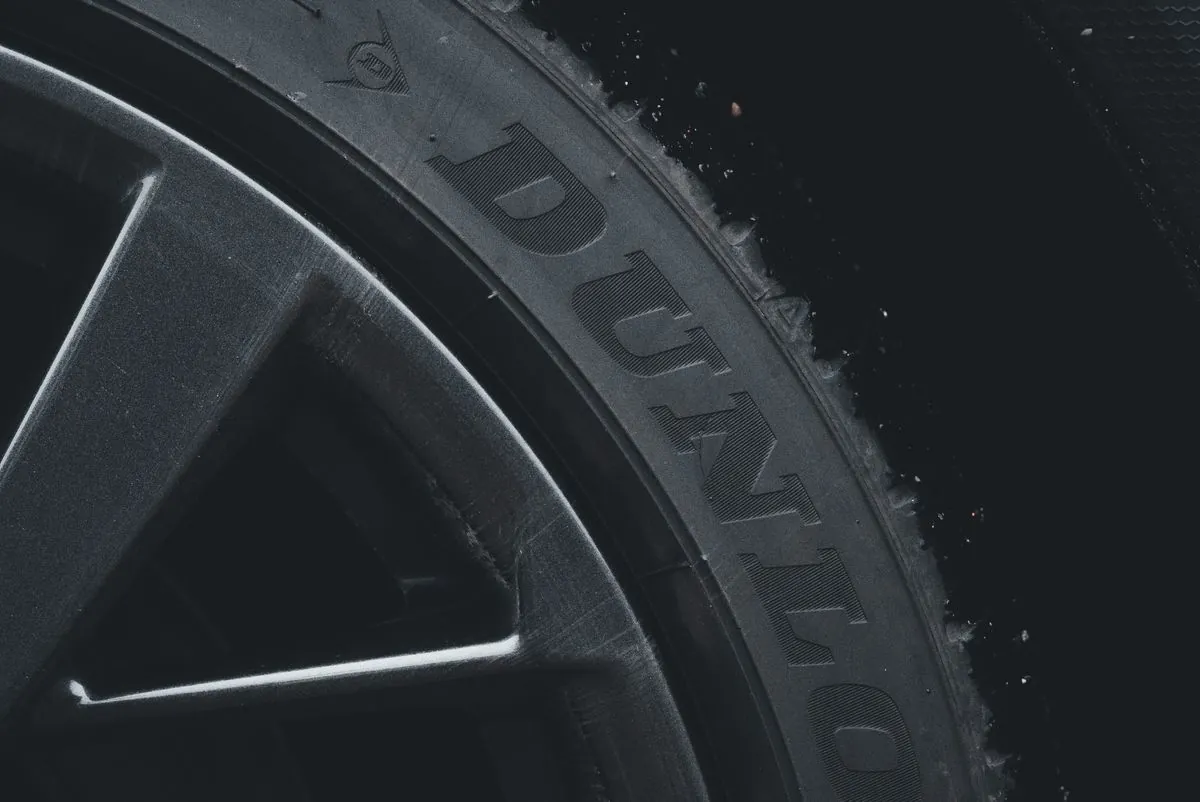
The tyre date code is the last four digits of the DOT code on the sidewall. The first two digits are the week the tyre was made and the last two are the year, so 3223 means week 32 of 2023. TyreSafe and Michelin both describe the code this way, and it takes seconds to read once you've found it.
Want it decoded for you? Enter the four digits into our tyre date code checker. The rest of this guide shows where the code hides, works through real examples, and explains what a tyre's age does and doesn't tell you.
Where is the date code on a tyre?
Look on the sidewall for the letters DOT. They're followed by a string of letters and numbers known as the tyre identification number, and the date code is the final group of four digits.
The DOT marking comes from US federal rules, which set out the identification number on a new tyre as a plant code, a manufacturer's code and then a four-digit date code as the final group (49 CFR 574.5). You'll find it on tyres sold in the UK too, and TyreSafe explains how to read it (TyreSafe).
The part that trips people up is which side to look at. The US rules require the full identification number on one sidewall, and Michelin notes that the date code appears on only one side of the tyre (Michelin). If the outer face shows DOT and some characters but no four-digit group, the date is almost certainly on the inner sidewall, facing under the car.
To find it without lifting the car:
- Front tyres: turn the steering to full lock so the inner sidewall swings into view.
- Rear tyres: reach your phone behind the tyre with the torch on and take a photo or short video as you move it around.
- Dirt: the moulding is shallow, so wipe the area with a damp cloth first.
- Hidden section: if the code is on the part touching the ground, roll the car forward half a wheel turn.
How to read a tyre date code
Split the four digits into two pairs:
- First two digits: the week of manufacture.
- Last two digits: the year of manufacture.
TyreSafe describes it exactly that way: a four-digit number where the first two numbers represent the week the tyre was made and the second two the year. Michelin gives the example 4714, meaning week 47 of 2014.
How precise is a week number? Under the US rule, week 01 is the first full calendar week of the year, running Sunday to Saturday, and the regulation's own example is 0109, the first full week of 2009. So the code pins manufacture to a specific week rather than a month. For everyday purposes, turning it into an approximate month is plenty.
What about everything before those four digits? Under the same US rule, the earlier characters on a new tyre are a plant code identifying the factory and a manufacturer's code, so none of them tell you anything about age. You can ignore them when you're dating a tyre. The only characters that matter for age are the final four, which is why it pays to find the end of the string rather than start reading from the letters DOT.
The most common mistake is reading the pairs the wrong way round. The code is week, then year. It's never year then week, and it's never a month. A tyre marked 1223 was made in week 12 of 2023, in late March, not in December 2023.
Worked examples: reading real date codes
Here are six codes decoded. The week and year come straight from the digits; the month column is an approximation using the week numbering described above.
| Date code | Week | Year | Roughly when it was made |
|---|---|---|---|
| 3223 | 32 | 2023 | Early August 2023 |
| 0526 | 05 | 2026 | Early February 2026 |
| 4521 | 45 | 2021 | Early November 2021 |
| 1219 | 12 | 2019 | Late March 2019 |
| 5118 | 51 | 2018 | Late December 2018 |
| 4714 | 47 | 2014 | Late November 2014 |
Once you have the date, working out age is subtraction. Checked in September 2026, a tyre coded 3223 is just over three years old. The one coded 5118 is more than seven and a half years old, and 4714 is nearly twelve.
Notice the leading zero in 0526. Week numbers below 10 are always written with a zero in front, so a four-digit code never starts with a single digit week. If you're reading a code off a photo, count the characters to make sure you have all four.
Decode it with our tyre date code checker
If you'd rather not count weeks, use the Rescue Tyres tyre date code checker. Enter the four digits from your sidewall and it does the conversion for you.
It's especially handy when you're checking several tyres at once: the four on a used car you're thinking of buying, the spare in the boot, or the tyres on a caravan, trailer or motorhome before the first trip of the season. Write each code down, run them through the checker, and you'll see straight away whether one tyre is much older than the rest.
Does tyre age matter if the tread is fine?
Yes, age is worth knowing even when there's plenty of tread. The British Tyre Manufacturers' Association (BTMA) advises that older or infrequently used tyres should be regularly inspected for early signs of deterioration, and highlights spare wheels and trailer tyres in particular (BTMA). It says deterioration can show as cracking or crazing on the sidewalls and in the tread grooves, and can also show up as increased noise or vibration.
The government has looked at this too. In 2019 it said research it had commissioned showed that ageing tyres suffer corrosion which could cause them to fail (GOV.UK).
What the date code can't tell you is how a particular tyre has been stored or used. BTMA's advice is to consult a trained and qualified tyre professional if you're unsure whether a tyre needs replacing. Our guide to cracked and perished tyres shows what to look for, and how old is too old for a tyre goes deeper into age and replacement.
Is there a legal age limit for tyres in the UK?
Not for private cars. The age limit in UK law applies to specific heavier vehicles. BTMA explains that since 1 February 2021 it has been illegal to use tyres more than 10 years old on the front steered axles of heavy goods vehicles, buses and coaches. The government's announcement also covered single-wheel fitments on minibuses, across England, Scotland and Wales (GOV.UK). The rules sit in regulation 27 of the Construction and Use Regulations, with exceptions for certain vehicle categories (legislation.gov.uk).
The same change made a clearly visible date of manufacture mandatory on each tyre for those vehicles, and required retreaded tyres to carry the date of retreading. On a retread, BTMA advises always using the most recent remanufacture date rather than the original casing's date.
For a car, an old tyre isn't automatically illegal, but its condition can be. A tyre with a cut deep enough to reach the ply or cord, or with any cord exposed, breaks the rules whatever its age.
Checking dates on new tyres, spares and used cars
New tyres. A new tyre won't have been made this week, because tyres are manufactured, shipped and stocked before they're sold. If the manufacture date matters to you, ask before the tyre is fitted rather than afterwards. Our list of questions to ask before buying tyres is a good place to start.
Spare wheels. BTMA singles out spare wheels because they're used so rarely. A spare can easily be the oldest tyre on the car, so check its code and its pressure. See spare wheel maintenance.
Caravans, trailers and motorhomes. These often stand for long periods between trips, which is exactly the infrequent use BTMA describes. Read the codes at the start of each season.
Buying a used car. Check every tyre and the spare. Codes years apart suggest tyres replaced one at a time, and a set that's all old gives you a fair question to put to the seller. If a tyre looks second-hand rather than new, ask how old it is.
Can't find or read the date code?
Start with the inner sidewall, since the code is on one side only. If the digits are scuffed or packed with dirt, clean the area and shine a torch across the sidewall at a low angle. The shadows it throws make shallow moulded numbers much easier to read, and a phone photo lets you zoom in.
If you still can't find a four-digit date, or what you find doesn't make sense, don't guess. Ask a tyre professional to look at it, as BTMA recommends whenever you're unsure.
If the code tells you it's time for new tyres, Rescue Tyres can fit them at your home or workplace across London and the Home Counties. Call or WhatsApp 07473 720871 or book online. We source budget, mid-range and premium tyres in your car's size and confirm the price on the call before any work starts. See the tyres we fit.
