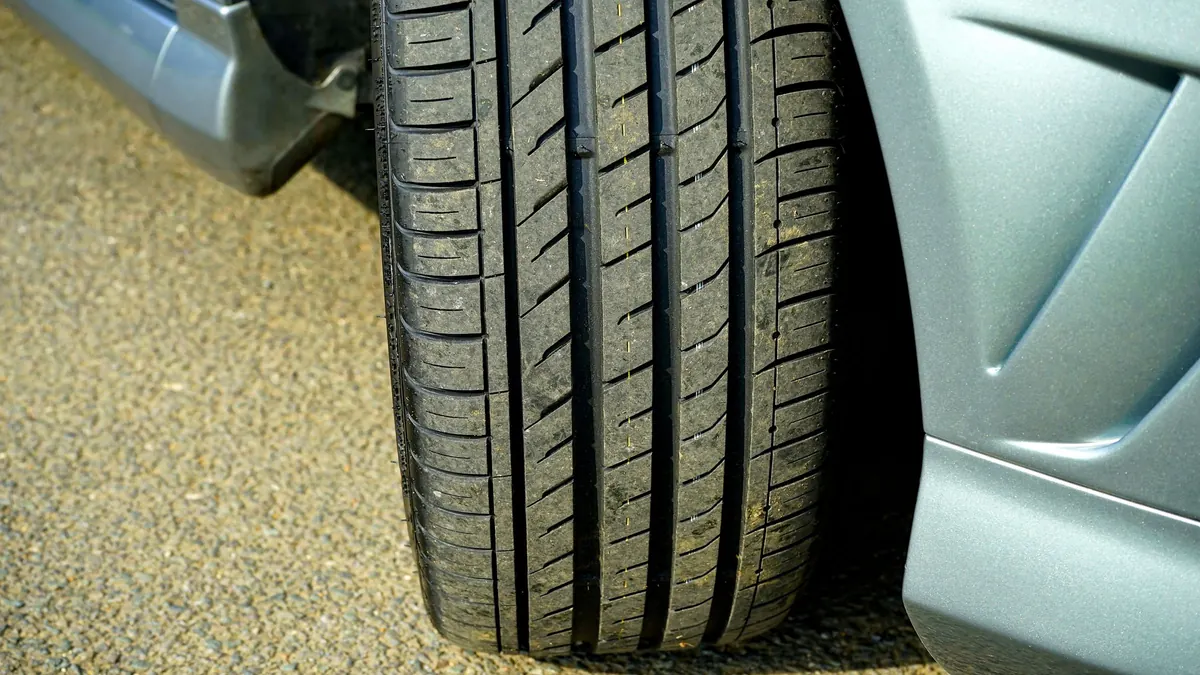
The spare is the most forgotten tyre on the car, and it's no use at all if it's flat or perished when you finally need it. A few minutes every few months keeps it ready: check the pressure, the condition and, once a year, the age. Knowing what type of spare you have, or whether you have one at all, matters just as much.
The forgotten tyre
Because the spare sits unused under the boot floor for years, it's easy to forget, until the moment you need it on a dark roadside. By then it's too late to discover it's flat. Treat it as a tyre that needs occasional attention, not a fit-and-forget item, and it'll be there when it counts. Our guide to spare wheel versus repair kit compares the two.
What to check
- Pressure: check it every few months and set to the figure in your handbook (space-savers often need a high pressure).
- Condition: look for cracks, perishing and any damage.
- Age: check the DOT date yearly, as it ages even unused.
- The kit: make sure the jack, brace and locking nut key are present.
A full-size spare you might drive on for a while still has to meet the same 1.6mm legal minimum tread across the central three-quarters, and be free of cuts and bulges, as any other tyre in use (TyreSafe).
Space-saver rules
Many cars carry a narrow space-saver rather than a full-size spare. It's only meant to get you to a fitter: it's usually limited to around 50mph and short distances, and it often needs a higher pressure than your normal tyres. Don't treat it as a normal wheel, and get a proper tyre fitted as soon as you can after using it.
If you have no spare
Many newer cars come with no spare at all, just a sealant repair kit, which only handles small tread punctures. Check what you actually have before you need it, and make sure any kit is in date. If you'd rather not rely on a kit, a mobile tyre fitter is a dependable alternative: see mobile tyre fitting.
Which type of spare do you have?
Lift the boot floor now, because what you find changes what you need to do. There are four common set-ups, and it is easy to be wrong about which one your car has, especially after buying used.
| What you find | What it means | What to check |
|---|---|---|
| Full-size spare on a matching wheel | Can be driven on normally once fitted, at the same speeds as the other tyres. | Pressure, tread, age and cracking, exactly as for a road tyre. |
| Full-size tyre on a plain steel wheel | Legal to drive on, but the steel wheel may need a different wheel nut type from your alloys. | Pressure and age, plus that the correct nuts are in the car. |
| Narrow space-saver | Temporary only. Speed and distance limits are printed on the tyre or a label on the wheel. | Pressure (often a high figure), age, and that the speed label is legible. |
| Sealant bottle and compressor | No spare. The kit only treats small tread punctures. | Sealant expiry date, compressor works from the 12V socket, tyres are not run-flats. |
If there is an empty well where a spare should be, a previous owner may have removed it, or the car was sold without one. You can usually buy a matching spare and jack second-hand or from a dealer, and it is worth doing before a long trip.
How to check the spare step by step
A proper spare check takes ten minutes and needs only a pressure gauge, a torch and a 20p coin. Do it on a dry day with the boot empty, and put a reminder in your phone for three months' time.
- Lift the boot floor and take the spare out completely, rather than reading the pressure in place. A wheel that has sat in a wet well can be rusting on the underside where you never see it.
- Check the pressure against the figure in the handbook or on the wheel label. Space-savers often need far more than a road tyre, so a reading that "looks about right" for a normal tyre can be badly low for a spare.
- Read the DOT date code on the sidewall. A spare that came with the car is the same age as the car, however good the tread looks.
- Look for cracking around the sidewall and in the tread grooves, and for a flat spot from years of resting on one side.
- Check the jack winds freely, the wheel brace fits your nuts, and the locking wheel nut key is present and undamaged. Try the key on one nut.
- Refit everything and tighten the retaining bolt, so the spare cannot shift and rattle.
Steel spares in a wet boot well corrode, and a corroded rim edge can stop the tyre sealing when it is finally used. Dry the well out and find the water leak, which is usually a perished light-cluster seal or a blocked drain.
After you have used the spare
A space-saver is a way to reach a fitter, not a fifth tyre, and the punctured wheel should be sorted within days rather than weeks. The speed limit printed on it (typically 50mph) and the short-distance guidance exist because the narrow tyre has less grip, less load capacity and a different rolling radius from the other three. Our tyre size calculator shows how much two sizes differ in diameter.
That difference in size matters more than people realise. On many cars a space-saver on a driven wheel confuses the traction control and ABS, and on four-wheel-drive cars it can strain the centre differential. Some handbooks tell you to fit the space-saver on the rear and move a full wheel to the front on a front-wheel-drive car; check yours.
If you had a full-size spare, you have more time, but the tyre may be a different make or a lot older than the other three. Mixing brands is legal on a car, but the best practice is matching tyres on the same axle; see replacing tyres in pairs.
Once the damaged tyre is repaired or replaced, put the spare back in the well at the correct pressure straight away, and put the jack and key back where they live. A spare that was never put back after it was last used is easy to miss.
The spare, the MOT and the law
A stowed spare is not inspected during the MOT, but the moment it is on the car it has to meet the same legal standard as any other tyre.
That means at least 1.6mm of tread across the central three-quarters, no cuts exposing the cords, no lumps or bulges, and a tyre suitable for the vehicle. The rules are set out on GOV.UK.
A space-saver is designed to be legal on the road within its limits, so using it briefly is fine. Driving on it for weeks at motorway speeds is not, and a police officer can treat an unsuitable tyre in the same way as a worn one, with a fine of up to £2,500 and 3 penalty points per tyre.
Because the MOT does not check the spare, a perished or flat spare can pass through years of tests unnoticed. Nobody else will look at it, which is the whole point of putting it in the diary.
Having the spare checked
Ask the fitter to check your spare's pressure, condition and age while they are with you; we can fit a fresh tyre if it needs one.
