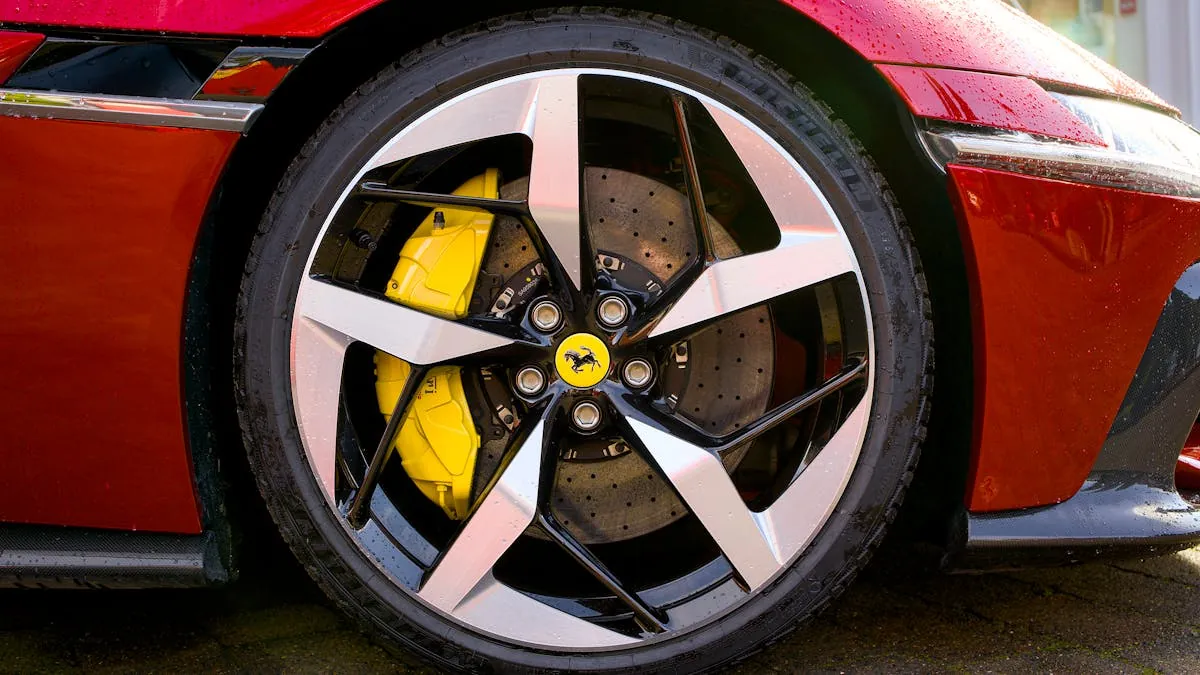
Direct TPMS sensors live inside each wheel and run on a sealed battery, so when that battery dies, usually after several years, the sensor needs replacing. The job is done with the tyre off the wheel and the system reprogrammed afterwards. Because a faulty TPMS fails the MOT on cars from 2012, it's worth sorting rather than ignoring.
Why TPMS sensors fail
A direct TPMS sensor is a small unit, often built into the valve, that measures the pressure in each tyre and sends it to the car. Its battery is sealed in and can't be replaced on its own, so once it runs flat, typically after several years, the whole sensor is replaced. Sensors can also be damaged by corrosion or by careless handling during a tyre change.
Corrosion is the one you can influence. Many sensors use an aluminium valve stem, and a missing valve cap lets road salt and moisture attack it until it seizes or snaps. A cap on every valve, and a fresh service kit each time the tyre comes off, is cheap insurance.
How replacement works
Because the sensor sits inside the wheel, the tyre has to come off to reach it, which is why it's usually done at the same time as a tyre change. The old sensor is removed, a new one fitted, the tyre refitted and balanced, and the system "relearned" so the car recognises the new sensor. A service kit (new seals and valve core) is often fitted at the same time to keep it sealed.
What affects the cost
The cost depends on the sensor type and your car. Some cars take a universal programmable sensor; others need a specific part. There's also the labour of removing and refitting the tyre, and the relearn procedure. If you're replacing a tyre anyway, the extra cost of a sensor is lower because the tyre is already off. Ask for the price for your car to be confirmed before any work starts.
Do you have to replace it?
If the warning light is on because of a flat sensor, then yes, to clear it and pass the MOT: a malfunctioning TPMS is a major defect on cars first used on or after 1 January 2012 (source). First, though, it's worth ruling out a genuinely low tyre or a slow leak (see our slow puncture guide), because the light may simply mean a tyre needs air. If correct pressures don't clear it, the sensor is the likely cause.
Direct vs indirect TPMS: which does your car have?
Only cars with direct TPMS have sensors in the wheels to replace; indirect systems use the ABS wheel-speed sensors and have nothing inside the tyre at all. Knowing which you have is the first step, because it decides whether a sensor replacement is even the right job.
| Direct TPMS | Indirect TPMS | |
|---|---|---|
| How it works | A battery-powered sensor in each wheel measures pressure and transmits it | The car compares wheel speeds; a soft tyre rolls slightly smaller and spins faster |
| What you see | Often a pressure reading per wheel on the dash | A single warning light, no per-wheel figures |
| Parts to replace | Sensor, service kit, sometimes valve | None in the wheel |
| After topping up | Usually clears itself once pressures are correct; some need a reset | Needs a manual reset from the menu or a button |
| Typical fault | Flat sensor battery, corrosion, damage | Not reset after a top-up or tyre change |
If your dash shows an actual PSI or bar figure for each corner, you have direct TPMS. If it only shows a light, check the handbook, because a light that stays on with an indirect system usually needs the reset procedure rather than any parts. Our guide to the TPMS warning light covers what each type is telling you.
What a sensor replacement should include
A proper TPMS sensor replacement is a bundle of small jobs, and a quote that leaves one out can leave you with the light still on. Before you agree a price, check it covers all of these:
- The sensor itself. Either the vehicle maker's part, an equivalent from a sensor specialist, or a universal sensor that is programmed to your car before fitting.
- A service kit. New seal, nut, valve core and cap, so the new sensor does not leak air around the stem.
- Tyre removal and refit. The tyre has to come off the rim, then go back on and be re-seated.
- Balancing. Any time a tyre comes off the wheel it should be balanced again.
- Programming. A universal sensor needs its ID set, either cloned from the old one or created new.
- The relearn. Telling the car which sensor is in which corner. Some cars do this automatically on a short drive; others need a diagnostic tool.
The relearn is the step most often missed. If a fitter says the sensor is "fitted" but the light is still on a week later, ask whether the relearn was done and whether the car needed a tool to do it.
Replace one sensor or all four?
You can replace a single sensor, and that is the right call if one has been damaged; but if a battery has simply run down, the other three are the same age and will follow. The question is whether you want four separate visits or one.
The cost logic favours doing them together when the tyres are off anyway. Each swap needs the tyre removed, so replacing all four at a tyre change adds only the parts, whereas doing them one at a time as they fail means paying the labour four times.
If your car is at the age where sensor batteries start to go and the tyres are due, doing the set is usually the cheaper route over the next couple of years.
If the car is older and the tyres are not due, replacing the one that has failed is perfectly reasonable. Just expect the next one, and budget for it.
How to make TPMS sensors last
The sensor battery cannot be replaced, but most early failures are corrosion or damage, and those are avoidable.
- Keep valve caps on. They protect the stem and the core from salt and grit. A lost cap costs pennies to replace.
- Tell the fitter you have TPMS before any tyre work, so the tyre is broken from the bead on the opposite side to the valve.
- Think before using puncture sealant. Some products can coat the sensor and stop it reading correctly, and the cleaning is not always successful. See tyre sealant: good or bad.
- Fit a service kit every time the tyre comes off. The rubber seal and metal nut are wear items.
- Avoid kerbs. A hard scrape across the rim near the valve can crack the sensor body.
Valve types and their weak points are covered in tyre valve types explained. If you are unsure whether a light is a sensor fault or a soft tyre, checking all four pressures with a gauge is still the first move, and TyreSafe recommends doing that monthly regardless of what the dash says.
Getting TPMS checked at a tyre change
We fit tyres at your home or work across London and the Home Counties from our base at Brent Cross, NW2. If your car has TPMS, mention it when you book and we will tell you on the call what sensor work is possible for your car.
