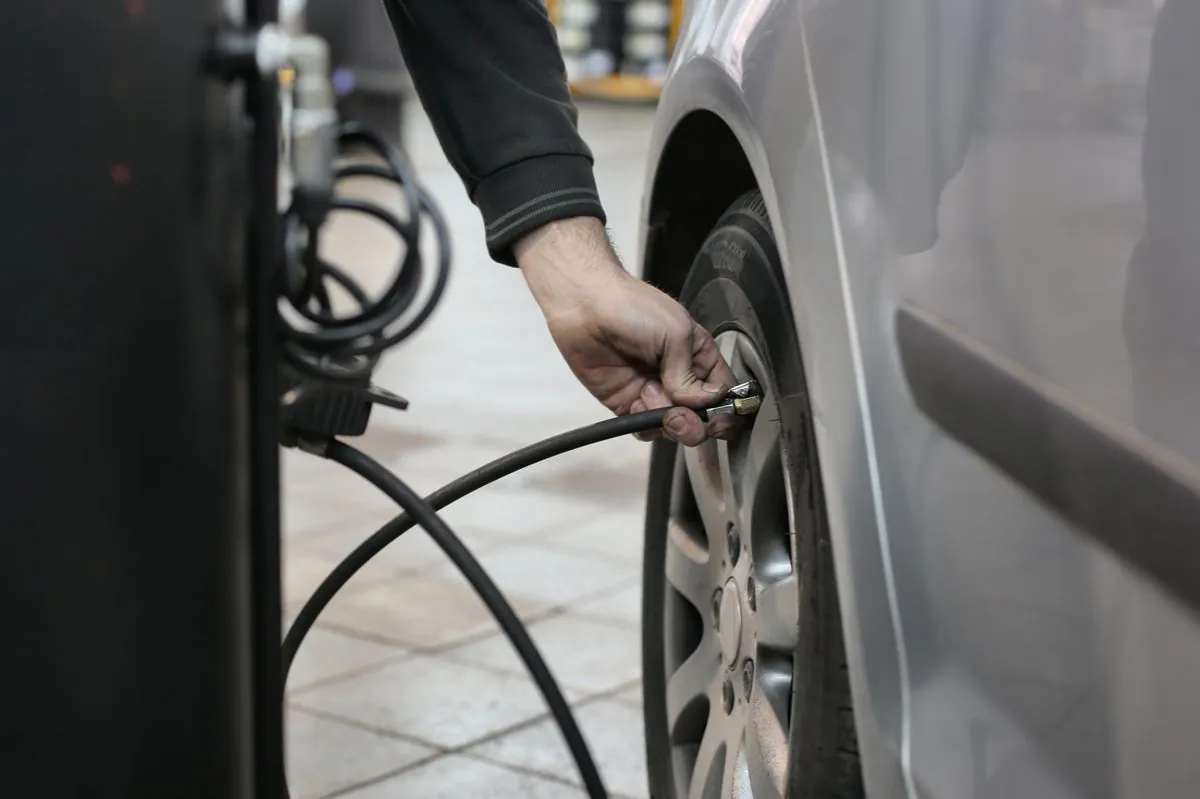
To reset the tyre pressure warning on a Nissan Qashqai, set all four tyres to the cold pressures on the placard on the driver side centre pillar, run [Calibrate] in the [Tyre Pressures] settings menu, then drive above 25 km/h (16 MPH). Both the current J12 and the previous J11 use a pressure sensor in each tyre valve, and Nissan's handbooks say the warning does not turn off by itself when you add air.
The steps below are taken from Nissan's UK owner's manuals for the 2023 model year J12 and the 2019 model year J11, and each section links to the exact document. Menu names can vary between editions and screen types, so if yours look different, follow the steps in your owner's manual.
Which tyre pressure system does your Qashqai have?
Both of the last two Qashqai generations use direct monitoring: a sensor built into each tyre valve that reads the actual pressure and temperature and sends it by radio to a receiver in the car. Nissan's UK handbooks describe the system as fitted "where fitted", so it is worth confirming on your own car, but on versions that have it the layout is the same.
| Generation | Roughly | System | Official source checked |
|---|---|---|---|
| Qashqai J12 | 2021 onwards | Direct: sensor in each tyre valve | UK owner's manual for the 2023 model year |
| Qashqai J11 | About 2014 to 2021 | Direct: sensor in each tyre valve | UK owner's manual for the 2019 model year |
| Qashqai J10 and earlier J11 editions | Before the editions above | Not verified here | Follow the steps in your owner's manual |
You can usually see the system working: both handbooks describe a [Tyre Pressures] screen in the vehicle information display between the dials that shows all four pressures while you drive, plus a tyre location indicator that points to the tyre that is low. The spare, where one is carried, is not monitored. For the general picture of how sensor systems differ from wheel-speed ones, read our explainer on the TPMS warning light.
Before you reset: where are the Qashqai tyre pressures?
Nissan is clear that the first job is always the pressures, not the menu. Both handbooks say to adjust all four tyres to the recommended COLD tyre pressure shown on the tyre placard on the driver side centre pillar, the upright part of the body you see when the driver's door is open.
- Cold means cold. Tyres warm up as you drive and read higher. Check after the car has been parked for a few hours, not after a long run.
- Use a gauge. The handbooks tell you to use a tyre pressure gauge rather than judging by eye.
- Laden pressures. If the car is heavily loaded, Nissan says to inflate to the "Laden Pressure" on the placard and set the system's target pressures to match (covered below).
- Check monthly. Both handbooks say each tyre, including the spare, should be checked monthly when cold, and that the TPMS is not a substitute for regular checks.
We have deliberately not quoted pressure figures. They depend on the wheel and tyre size and the load, so read them from your own placard. For background, see our correct tyre pressure guide and check your pressures monthly.
How to reset the tyre pressure warning on a Qashqai J12 (2021 onwards)
The J12 light does not switch itself off the moment you add air. The Nissan Qashqai owner's manual for the 2023 model year says the car must be driven above 25 km/h (16 MPH) to activate the TPMS and turn the warning off, and that you should reset the TPMS after adjusting the pressures. Its reset is a temperature calibration in the vehicle information display:
- With the tyres cold, adjust all four to the recommended pressure on the driver side centre pillar placard.
- If you are carrying a heavy load and have used the laden pressures, use the steering wheel switches to select [Settings], then [Tyre Pressures], and set [Target Front] and [Target Rear] to match.
- In the same [Settings] then [Tyre Pressures] menu, select [Calibrate] using the scroll dial. The message [Calibrate] shows while the process runs.
- Drive the car above 25 km/h (16 MPH) so the system can take fresh readings.
The handbook explains why this step exists. The sensors compensate for temperature to avoid false warnings, and [Calibrate] resets the previously stored temperature value. The settings chapter recommends it after pressures are adjusted, while the TPMS chapter describes it as something needed on rare occasions when you have adjusted the pressures and the outside temperature is very different from when it was last calibrated. Either way, calibrate only after the pressures are right.
How to reset the tyre pressure warning on a Qashqai J11 (2019 model year)
The J11 process is almost identical, with slightly different buttons and wording. In the Nissan Qashqai owner's manual for the 2019 model year the steps are:
- Adjust all four tyres, cold, to the pressure on the tyre placard on the driver side centre pillar.
- If the car is heavily laden, set [Target Front] and [Target Rear] under [Settings] then [Tyre Pressures] to the laden figures.
- Using the arrow and OK switches on the steering wheel, select [Settings], then [Tyre Pressures], then [Calibrate] followed by [Start]. The display shows [Resetting tyre pressure system] while it works.
- Drive above 25 km/h (16 MPH). The handbook notes the system may not operate correctly below that speed.
Earlier J11 editions and the J10 were not checked for this guide. If your menus do not match, follow the steps in your owner's manual. Nissan UK lets you download the handbook for your model and year from its owner's manuals page.
After new tyres, a wheel swap or a new sensor
Each Qashqai sensor has a registered wheel position, so moving wheels or fitting a sensor changes what the car expects. Both handbooks say Nissan recommends that a dealer registers a new sensor or sensor location, but they also give an owner procedure:
- Change the tyre position or have the new sensor fitted.
- Confirm the cold tyre pressures and perform the temperature calibration described above.
- Drive for several minutes between 25 km/h (16 MPH) and 100 km/h (64 MPH). The sensor IDs and positions are detected automatically.
The handbooks warn that the sensors may not synchronise on bad road surfaces, below 25 km/h or above 100 km/h, under hard acceleration or braking, or in stop and go traffic. They also include care points that matter at every tyre change:
- Never bend the valves when inflating or checking, and do not use metal valve caps.
- Fit the valve caps properly, because without them the valve and sensor can be damaged.
- Replace the sensor's valve stem, including the core and cap, when tyres are replaced for wear or age. The sensors themselves can be reused.
- Use only Genuine Nissan Emergency Tyre Repair Sealant or an equivalent. Other liquid or aerosol sealants may cause the sensors to malfunction.
A failed sensor needs replacing and registering. Our guide to TPMS sensor replacement explains what is involved, and tyre valve problems covers leaks that start at the valve.
Qashqai tyre pressure light staying on or flashing
Nissan separates a low tyre from a system problem by how the light behaves:
| What you see | What Nissan's handbooks say it means |
|---|---|
| Light on while driving, with a [Low tyre pressure] warning | One or more tyres are low. Stop safely, check all four and adjust to the placard. |
| Light flashes for about a minute at start-up, then stays on | The TPMS is not working properly, for example a missing or faulty sensor, a spare fitted or a replaced wheel. Have it checked by a Nissan dealer or qualified workshop. |
| Light stays on after the pressures are set and the system is reset | The TPMS may not be functioning properly. Have it checked. |
| [Check Cold Tyre] message | The pressure has risen above the target during a low pressure condition, usually because the tyre has warmed up. Recheck when cold. |
The J11 handbook's table also lists radio interference between the sensors and the receiver as a cause, and suggests driving away from the source. Both handbooks mention electrical devices plugged into the 12V supply, metallised window film, snow chains and wheels buried in snow. If the light comes on again within days of a proper reset, suspect a slow leak first: see slow puncture causes and fixes.
Is it safe to drive a Qashqai with the tyre pressure light on?
Only as far as a safe place to stop. Nissan's instruction when the light comes on while driving is to avoid sudden steering and abrupt braking, reduce speed, pull off the road to a safe location and stop as soon as possible. The handbooks warn that driving on under-inflated tyres can permanently damage them and make tyre failure more likely, and that the system may not detect a sudden loss of pressure such as a flat while driving.
- On a motorway, if the car is handling normally, slow down and leave at the next junction or services rather than stopping on the carriageway; if it is not, pull onto the hard shoulder or into an emergency area and get behind the barrier. If you are in danger, call 999. National Highways is on 0300 123 5000.
- If a tyre is flat, Nissan says to use the emergency repair kit or spare, where fitted, as soon as possible. A sealant repair is only temporary and the tyre should be inspected afterwards.
- A flashing light means the system may not warn you of a genuine pressure loss, so check the tyres manually until it is repaired.
The DVSA MOT inspection manual treats a tyre pressure monitoring system that is malfunctioning or obviously not working as a major defect on cars first used on or after 1 January 2012, which includes every J11 and J12.
When to get a mobile fitter to look at your Qashqai
It is time for a proper inspection if the warning returns after a correct reset, one tyre keeps dropping, you can see a screw or cut, or the light has flashed since a tyre or wheel change.
Rescue Tyres is fully mobile and works only on tyres and wheels, from one base at Brent Cross, NW2; London and the Home Counties are closest, and further out we tell you on the call whether we can take the job. Evenings, nights and weekends are covered when the diary allows, at the same price as a weekday job. The fitter checks all four pressures against your placard, inspects tread, sidewalls and valves, and carries out puncture repairs to BS AU 159 when the damage is repairable. If it is not, we fit a replacement in the right size where the car is; common sizes are often on the van, and other sizes are sourced for the job. Where the fault is in the monitoring system itself, you will be told so rather than sold a tyre you do not need.
The price is confirmed on the call before any work, and a realistic arrival time is agreed when you ring. Phone or WhatsApp 07473 720871, or book online.
