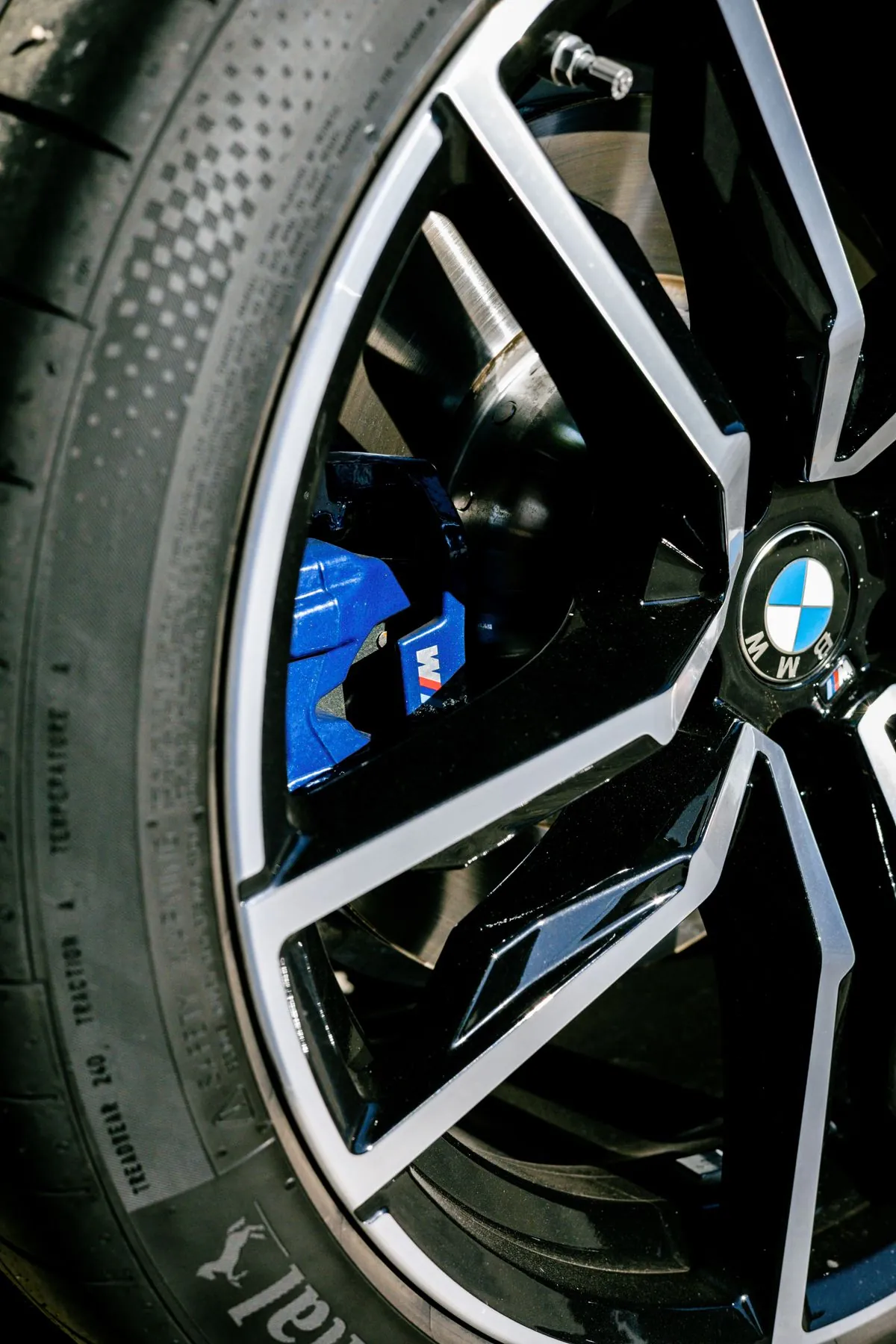
A kerb strike does three different kinds of damage, and only one of them is cosmetic. The scuffed lacquer everyone notices is the least important part. The same impact can bend the rim flange where it seals against the tyre, or press the sidewall hard enough to damage the casing inside. Those two are safety issues, and neither is obvious from the outside.
Check the tyre first, not the paint
Before you look at the alloy, run your hand round the tyre sidewall. You are feeling for three things:
- A bulge or blister. This means the internal cords have broken and the air pressure is pushing the rubber outward. A bulge is not repairable and the tyre needs replacing, as covered in our guide to sidewall damage.
- A cut or gouge deep enough to expose cords. Surface scuffing on the sidewall lettering is usually fine. Anything showing fabric or steel underneath is not.
- Slow air loss. A kerbing can break the seal between the tyre bead and the rim, which leaks slowly rather than dramatically.
TyreSafe advises treating cuts, lumps and bulges as defects to act on rather than monitor.
Is the rim actually bent?
A bent rim usually announces itself while driving rather than while parked. The classic signs are a vibration that appears or worsens at a particular speed, a steering wheel that shimmies, or a tyre that will not hold pressure despite no puncture being found.
You can sometimes see it: with the car safely raised and the wheel spun slowly by hand, a buckle shows as the rim edge moving in and out relative to a fixed point. In practice most buckles are small enough that they only show up on a balancing machine, which is why a persistent vibration after a kerbing is worth investigating rather than living with. Our guide to wheel balancing explains the difference between balance and buckle.
When it really is just cosmetic
If the tyre is sound, the wheel holds pressure and the car drives normally, what you have is a paint and lacquer problem. That is a refurbishment job rather than a safety one, and it can wait until it suits you. The one reason not to leave it indefinitely is corrosion: once the lacquer is broken, road salt gets into the bare alloy underneath and the damage spreads outward from the scuff.
Whether refurbishing is worth it against replacing the wheel depends on the wheel, and we cover that trade-off in wheel refurbishment vs replacement.
Alignment after a hard kerbing
A hard enough kerb strike can move suspension geometry as well as damage the wheel. The symptoms overlap with a buckled rim, which is what makes this confusing: both can cause pulling, uneven wear and odd steering feel.
The distinguishing sign is wear pattern. A tracking problem scrubs one edge of the tread away over hundreds of miles; a buckled rim causes vibration without that characteristic edge wear. If you are seeing that wear, have the alignment checked.
What a fitter checks after a kerbing
If you book a check after a hard kerb strike, this is what a proper inspection covers. It takes fifteen minutes with the wheel off, and it settles the cosmetic-or-not question definitively.
- The tyre, inside and out. The inner sidewall is the one you cannot see from the kerb, and a strike that scuffs the outer face can also pinch the inner sidewall against the rim.
- The bead seat. The lip of the rim where the tyre seals. A kerb can dent it, and a dented bead seat leaks slowly no matter how good the tyre is.
- Run-out on the balancer. Spinning the wheel on a balancing machine shows a buckle as a wobble the eye cannot see, and shows whether the weights have been knocked off.
- The valve and sensor. A kerb close to the valve can crack a rubber valve or damage the stem of a TPMS sensor.
- Wheel nut torque. Any wheel that comes off should go back on at the correct torque, and it is a chance to confirm nothing had worked loose.
- The other side. If the car was dragged along a kerb or bounced off one, the other wheels on that side get a look too.
A fitter cannot check alignment at the roadside, but they can read the tread for the shoulder wear that points to it. If you also notice the car pulling or the steering wheel vibrating, have the alignment and wheel balance checked.
Repair, refurbish or replace the wheel?
Once you know what is damaged, the decision is mostly practical.
| Damage | Sensible option | Notes |
|---|---|---|
| Scuffed lacquer and paint on the rim lip | Cosmetic refurbishment, when convenient | Do it before corrosion spreads under the lacquer; no safety issue |
| Small dent in the rim lip, tyre holding pressure | Monitor, or specialist straightening | Check pressure weekly for a month; a bead leak may develop |
| Buckle causing vibration or air loss | Specialist straightening or replacement | Straightening suits mild buckles; anything severe is a replacement |
| Crack anywhere in the wheel | Replace | A cracked alloy is not a candidate for welding at home; treat it as unsafe |
| Bent so far the tyre will not seat | Replace | Do not attempt to drive on it |
Refurbishment restores the finish; it does not make a bent wheel round. Straightening is a separate skill and not every buckle can be corrected safely, particularly on wheels with thin, decorative spokes.
If a replacement is needed, a matching used wheel of the correct size and offset is often the cheapest route, and steel wheels are far more tolerant of kerbs if the car came with them.
To tell a buckle from a balance problem, see our guide to buckled alloy wheel signs.
Claiming for the damage
Most kerb strikes are the driver's own doing, and there is nobody to claim against. Two situations are different.
If the kerb or road edge was defective, such as a collapsed kerb stone, a raised ironwork cover or a pothole at the edge of the carriageway, the highway authority has a duty under the Highways Act 1980 to maintain the road, and you can submit a claim for the cost of the wheel and tyre.
Councils have a defence if they can show they inspected and repaired the road to a reasonable standard, so most claims turn on whether the defect was reported before. Our guide to pothole damage claims sets out the steps and what evidence to gather.
If the tyre was sold with a road-hazard guarantee, a sidewall cut or bulge from a kerb may be covered for a replacement, usually within a set period and with proof of purchase.
A comprehensive insurance policy may also cover the damage, but the excess usually makes a single wheel not worth claiming for.
In every case the evidence is the same: photographs of the kerb or defect with something for scale, the wheel and tyre damage, the date code and tread depth of the tyre, and the receipt for the repair. Do it the same day, because kerbs get mended and memories fade.
And whatever the outcome, a tyre with a bulge is not one to keep driving while the paperwork moves; the law on tyre condition, including the 1.6mm tread minimum, is summarised on GOV.UK.
What we do about it
After a kerbing, the first job for our mobile fitters is always the same: work out whether the tyre is still safe. If it is not, we can supply a replacement and fit it at your home, at work or at a safe place off the road. We work from one base at Brent Cross, NW2; London and the Home Counties are closest, and further out, call and we will tell you whether we can take the job. If the tyre is fine and the wheel is buckled, we will tell you that too rather than sell you a tyre you do not need. We do not straighten or refurbish wheels ourselves, so that work goes to a specialist wheel repairer.
