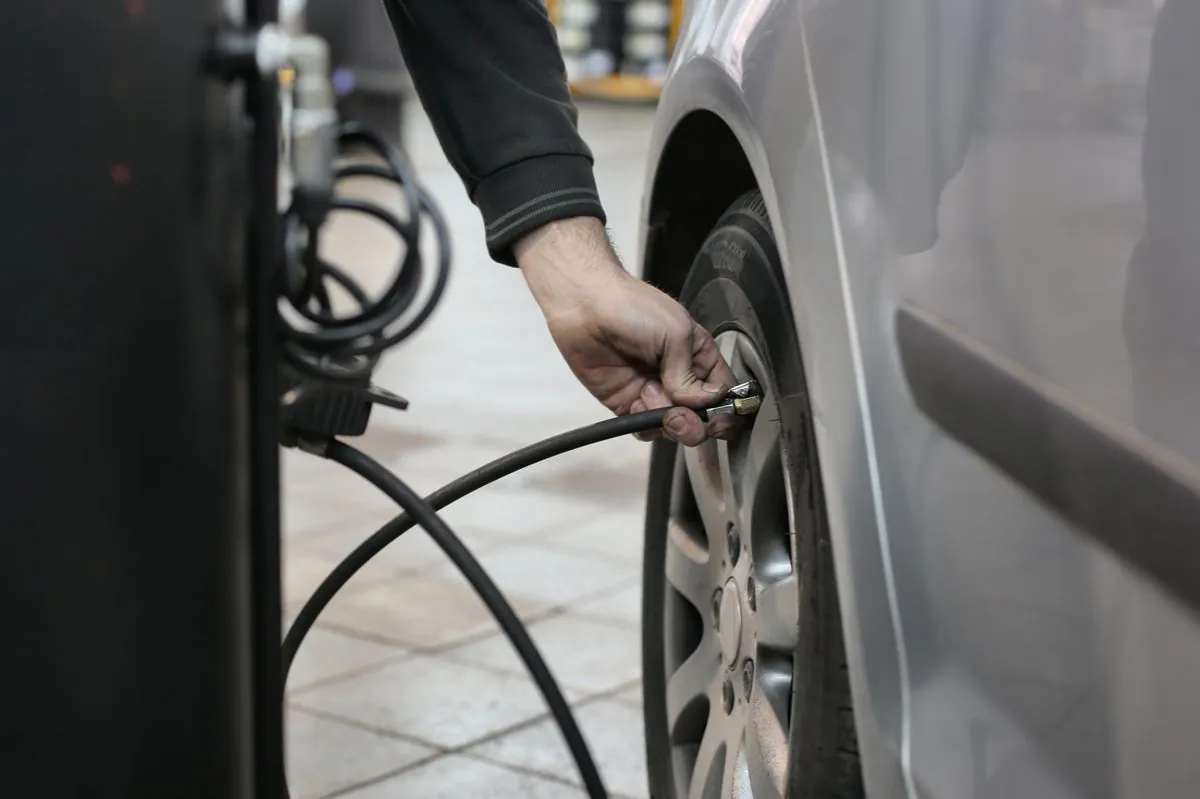
To clear the tyre pressure warning on a Peugeot 208, inflate all four tyres to the cold pressures on the label first, then reinitialise the under-inflation detection system in the menu your generation uses. The order matters more on a 208 than on many cars. Peugeot's handbooks are explicit that the system compares the wheel speed sensors against stored reference values, and that those reference values are whatever the tyres happened to be at when you last pressed reset. Reset with a soft tyre and you have simply told the car that soft is normal.
Every instruction below is taken from a named edition of Peugeot's own owner's manual, published free on Peugeot's owner documentation site, so you can open the same edition for your car's first registration date and compare. Where Peugeot has not published an English edition covering a particular year, this guide says so rather than guessing at a menu name.
Which tyre pressure system does your Peugeot 208 have?
Both 208 generations use the same underlying design: an indirect system that never measures pressure at all. It watches how fast each wheel is turning, because a tyre losing air gets slightly smaller in diameter and therefore spins slightly faster than the others. Peugeot calls it under-inflation detection rather than a tyre pressure monitor, and the 2025 edition of the manual describes it as comparing "the information given by the wheel speed sensors with reference values, which must be reinitialised every time the tire pressures are adjusted or a wheel changed".
What changes between model years is where Peugeot put the reset. Here is what each published English edition of the handbook says.
| Handbook edition (by first registration) | Car | System | Where the reset lives |
|---|---|---|---|
| 31/03/2012 to 30/04/2014 | 208 first generation | No under-inflation detection section in the handbook | Nothing to reset |
| 01/05/2014 to 31/01/2017 | 208 first generation | Under-inflation detection, wheel speed based | Touch screen Driving assistance menu, or a button on the side switch panel |
| 01/10/2019 to 31/10/2023 | 208 second generation and e-208 | Under-inflation detection, wheel speed based | Driving / Vehicle touch screen menu |
| From 01/11/2023 | 208 second generation and e-208, including the facelift | Under-inflation detection, wheel speed based | Depends on the infotainment fitted, see below |
Two honest gaps are worth flagging. Peugeot's site carries no English first generation edition after 31/01/2017, even though the first generation 208 stayed on sale in the UK until 2019, and none between that date and the second generation launch edition dated 01/10/2019. If your 208 falls in that window, the handbook that came with the car is the authority, and the routes described below are the ones to look for.
What has to be true before you press reset?
Peugeot puts a warning box directly above the reset instructions in both generations. The 2025 edition says: "Before reinitialising the system, make sure that the pressures of the four tire are correct for the conditions of use of the vehicle and conform to the values written on the tire pressure label. Check the pressures of the four tires before performing the reinitialisation. The system does not advise if a pressure is incorrect at the time of reinitialisation." The first generation handbook says the same thing in almost the same words.
- Find the label, not a figure from the internet. On the first generation, the handbook lists the tyre and paint label as being fitted to the middle pillar on the driver's side. On the second generation, the manual tells you to check pressures "referring to the label in the door aperture on the driver's side". Open the driver's door and the label is on the pillar or the frame it closes against.
- Cold means cold. Peugeot defines it as the vehicle stopped for one hour, or after a journey of less than six miles at moderate speeds. Otherwise, the handbook says to add 0.3 bar to the figures shown on the label, which is roughly four and a half psi.
- Match the load. The label gives more than one set of figures. The right column depends on how many people and how much luggage you are carrying.
- Do all four. An indirect system compares wheels against each other. Correcting one tyre and leaving the other three where they are can leave the comparison just as far out.
We have deliberately not printed pressure figures here. They vary by engine, wheel size and load, and the label on your own car is the only version that applies to it. TyreSafe's guidance on tyre pressure makes the same point, and the 2023 and 2025 editions of the 208 manual ask for a check every month as well as before a long journey. Our correct tyre pressure guide covers the routine.
How to reset the light on a 208 or e-208 from 2019 onwards
The second generation 208, including the electric e-208, keeps the reset in the touch screen. The exact path depends on which infotainment system your car was built with, and Peugeot lists them separately in the handbook edition dated 01/11/2023 onwards.
- Set all four tyres to the correct cold pressures from the driver's side door aperture label.
- Park up. Every edition specifies that the reinitialisation is done with the vehicle stationary.
- Open the touch screen menu listed for your car in the table below.
- Confirm when asked. The handbook says the reinitialisation is confirmed by a message on screen and an audible signal.
| Infotainment | What Peugeot's handbook says | Edition checked |
|---|---|---|
| Cars covered by the 2019 and 2020 editions | "With the vehicle stationary, the system is reinitialised via the Driving / Vehicle touch screen menu." | 01/10/2019 to 30/11/2020 and 01/12/2020 to 31/10/2023 |
| Touch screen 10 inch with Bluetooth Radio and Telephone | Reinitialised via the Driving touch screen menu | From 01/11/2023 |
| PEUGEOT Connect Radio or PEUGEOT Connect Nav | Reinitialised via the Driving / Vehicle touch screen menu | From 01/11/2023 |
| PEUGEOT i-Connect or i-Connect Advanced | Reinitialised in the Settings then Vehicle touch screen application, then select Safety then Tire Pressure Setup, then press YES to confirm | From 01/11/2023, and the edition from 02/05/2025 |
That last one is worth reading twice, because it is the path most current 208 and e-208 owners will need and it is three levels deep. Peugeot's English text spells the on screen item "Tire Pressure Setup", using the American spelling, so do not go hunting for a "Tyre" heading that is not there. Sources: the 01/10/2019 to 30/11/2020 edition, the 01/12/2020 to 31/10/2023 edition, the edition from 01/11/2023 and the owner's manual for cars registered from 02/05/2025.
Two extra notes from the same chapter. Snow chains do not require a reinitialisation, fitted or removed. And the handbook warns that the alert is not triggered instantly by a blowout or a sudden loss of pressure, because analysing the wheel speed readings "can take several minutes", with the alert possibly delayed below 25 mph or when you are driving hard.
How to reset the light on a first generation 208 (2012 to 2019)
Here the answer splits by how your car is equipped. The edition covering 01/05/2014 to 31/05/2015 and the edition covering 01/06/2015 to 31/01/2017 both describe two routes side by side.
With a touch screen. From the Driving assistance menu of the touch screen, press "Under-inflation initialisation", then confirm by pressing "Yes". The handbook says an audible signal and a message confirm the reinitialisation, and that "the new pressure settings registered are considered to be reference values by the system".
Without a touch screen. There is a physical button. The overview pages of the handbook label it on the side switch panel, the small bank of switches beside the other deactivation buttons, and describe it as "reinitialise the under-inflation detection (without touch screen)". The instruction is: with the ignition on and the vehicle stationary, press that button for about three seconds then release it, and an audible signal confirms the reinitialisation.
The same edition also notes that a label attached to the middle pillar on the driver's side reminds you that the system must be reinitialised after adjusting a pressure or changing a wheel. Sources: the 01/05/2014 to 31/05/2015 edition and the 01/06/2015 to 31/01/2017 edition.
If your 208 is from 2012 or 2013, it may have nothing to reset. We checked the 31/03/2012 to 31/01/2013 edition and the editions covering 01/02/2013 to 30/04/2014, and none of them contains an under-inflation detection section at all. Under-inflation detection first appears in the edition dated 01/05/2014, so an early first generation car may simply not have the system at all. On those early cars, a warning lamp on the dash is more likely to be something else, and a pressure gauge is the only way to know what the tyres are doing.
Does a Peugeot 208 have tyre pressure sensors in the wheels?
Every English 208 handbook we checked, across both generations, describes only the indirect design that reads the wheel speed sensors. None of them describes a system with a pressure sensor inside each wheel, and none of them shows a screen listing a pressure figure per tyre. That matters in practice for three reasons.
- There is nothing to clone or programme after a tyre change. On a 208 with under-inflation detection, a new tyre does not need a sensor matched to a wheel position. It needs the pressures set and the system reinitialised.
- The car cannot tell you which tyre. An indirect system knows that one wheel is turning differently, not that the front left is at a specific pressure. You still need a gauge.
- A space saver can switch it off. The second generation handbook says the use of a non standard or space saver spare "may suspend tire pressure monitoring", the malfunction lamp comes on, and it disappears once a wheel of uniform size is refitted, the pressure readjusted and the reinitialisation carried out.
One caveat, stated plainly. The first generation warning lamp table describes the flashing then fixed fault warning as meaning the system "has a fault or no sensor is detected on one of the wheels", which is wording carried across Peugeot's shared handbook text. If your own 208 displays an actual pressure reading for each tyre, it has sensors of some kind and the advice in your handbook takes priority over this page. Our explainer on what the TPMS warning light means covers the difference between the two designs.
Steady, flashing, or with the service light: what each one means
How the symbol behaves tells you whether to look at the tyres or at the system. Both generations use the same two warning states; the space saver adds a third case.
| What you see | What Peugeot says it means | What to do |
|---|---|---|
| Warning lamp on steadily, usually with a beep and a message | The pressure in one or more tyres is too low | Reduce speed, avoid sharp steering and sudden braking, stop when it is safe, check all four cold, then reinitialise |
| Warning lamp flashing then steady, with the service lamp lit | The under-inflation detection system itself has a fault, and monitoring is no longer performed | Check the tyre pressures yourself and have the system looked at by a Peugeot dealer or a qualified workshop |
| Lamp on after fitting the space saver spare | Monitoring may be suspended by the non standard wheel | It clears once a full size wheel is back on, the pressure is set and the system is reinitialised |
Peugeot adds a caution that applies to any indirect system: "The loss of pressure detected may not always cause visible deformation of the tire. Do not rely on just a visual check." A tyre can be well below its correct pressure and still look normal from the kerb.
Why does the light keep coming back after a reset?
If you corrected the pressures, reinitialised, and the warning returns within a few days, the reset is not the problem. Air is still leaving a tyre. The possible causes are:
- a nail, screw or shard of glass in the tread, which can seal itself well enough to leak slowly rather than go flat
- a corroded or perished valve, which leaks steadily with no visible damage to the tyre at all
- a poor seal at the rim, common after a kerb strike or on an alloy with corrosion on the bead seat
- a genuine seasonal drop, because cold air contracts and pressure falls with the outside temperature
The fourth one is the innocent explanation and the one people meet every autumn. It is covered in our guide to tyre pressure in cold weather. The first three are not innocent, and topping the tyre up again each week is not a fix. Our guide to slow puncture causes and fixes explains how to find one, and can a puncture be repaired sets out which damage can legally be plugged and which cannot.
There is one more reason a 208 light refuses to clear: the reset was never actually accepted. On both generations the handbook describes a confirmation, a message and an audible signal on the second generation, an audible signal on the first. If you did not get one, the car was probably not stationary, or the ignition was not on, or you were in the wrong menu.
Is it safe to drive a Peugeot 208 with the tyre pressure light on?
Not for long, and not at normal speeds. Peugeot's own instruction when the under-inflation alert appears is to reduce speed immediately, avoid excessive steering movements and sudden braking, and stop the vehicle as soon as it is safe to do so. The handbook then tells you to check all four tyres cold with a compressor, and if that is not possible straight away, to drive carefully at reduced speed.
- On a motorway, do not inspect the tyres on the carriageway. If the car is handling normally, slow down, leave at the next junction or services and check there; if not, use the hard shoulder or an emergency area and get behind the barrier. The Highway Code's rules on breakdowns set out what to do if you cannot keep going, and if you are in danger, call 999. National Highways can be reached on 0300 123 5000.
- Stop straight away if the steering pulls, you hear a flapping or rumbling noise, or a tyre is visibly flat. Running a tyre flat wrecks the sidewall in a very short distance and turns a repairable puncture into a replacement tyre.
- A flashing lamp is not a free pass. It means the car has stopped watching, so you are back to checking with a gauge yourself until it is fixed.
There is an MOT angle too. The DVSA MOT inspection manual lists "tyre pressure monitoring system malfunctioning or obviously not working" as a major defect, and says the TPMS inspection applies to M1 vehicles first used on or after 1 January 2012. That covers every 208 of both generations. The manual also notes that a lamp which stays on because a pressure is low does not automatically mean the system has a malfunction, which is exactly why getting the pressures right and reinitialising properly before a test is worth the ten minutes.
When to get a mobile tyre fitter to look at it
Call someone out rather than pumping it up again if:
- the warning returns within days of correcting the pressures and reinitialising
- one tyre keeps going down, or you can see a nail, a cut or a bulge in the sidewall
- the lamp flashes, or stays on after a tyre or wheel change
- the tyre is too soft to drive on safely, or you are not confident checking it yourself
If any of those apply, a mobile fitter can set all four pressures from your 208's own label, find where the air is going and carry out puncture repairs to BS AU 159 where the damage is in the repairable area. If the fault is the detection system itself, you should be told that plainly rather than sold a tyre.
