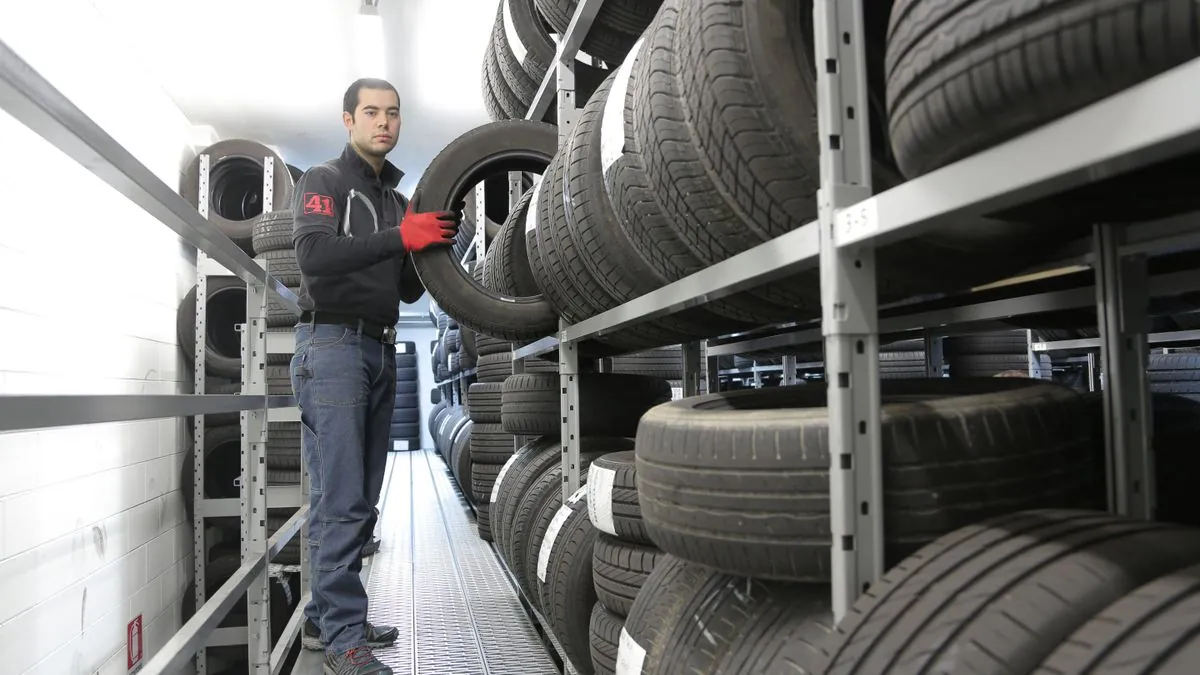
Whole tyres haven't gone to UK landfill for years, so old tyres are recycled or recovered instead. A worn tyre has plenty of life left as a raw material, and the UK has a well-established system for turning it into useful products. When a fitter replaces your tyres, the old ones should go into that system rather than to waste.
No more landfill
Sending whole tyres to landfill has long been banned in the UK on environmental grounds, and shredded tyres followed. That's driven a recycling and recovery industry that handles the millions of tyres replaced each year, keeping them out of the ground and putting the material back to use. A garage can't simply bin, bury or burn old tyres either; as a business it has a legal duty of care to pass its waste only to a registered carrier and to keep a record of where it goes (GOV.UK). Responsible disposal is part of any proper tyre-fitting service.
What old tyres become
An old tyre can take several routes depending on its condition:
- Reuse as a part-worn, where it legally meets the standard (though many don't).
- Retreading, common for truck and bus tyres, where a new tread is bonded to a sound casing.
- Crumb rubber, shredded and ground for sports pitches, playground surfaces, roads and new products.
- Energy recovery, where suitable tyres are used as fuel in cement kilns and similar.
The recycling process
Tyres collected from fitters are sorted by condition. Sound casings may be retreaded; the rest are typically shredded and separated into rubber, steel and fibre. The rubber is ground into crumb of various sizes for different uses, the steel is recycled as metal, and the fibre is recovered too. Very little is wasted, which is the point of the system.
| Part of the tyre | Roughly what it is | Where it typically ends up |
|---|---|---|
| Rubber compound | The bulk of the tyre by weight | Crumb and granulate for surfaces, mats, moulded products; fuel for energy recovery |
| Steel belts and bead wire | The reinforcing cords under the tread and in the bead | Separated by magnets and sold as scrap steel |
| Textile cords | Polyester or nylon plies in the casing | Recovered as fibre for fuel or insulation-type products |
What happens to your old tyres
When a fitter replaces your tyres, they take the old ones away, and a small disposal charge is usually part of the fitted price. They're then collected by a registered waste carrier, with a waste transfer note for each load, and sent for recycling or recovery, so you don't have to think about it, see eco and sustainable tyres for the wider picture.
Can you dispose of tyres yourself?
As a private individual you can usually take a small number of car tyres to your local household waste recycling centre, but check your council's rules first. Many sites limit the number per visit, some charge per tyre, and some do not accept tyres at all, so a wasted trip is common.
What you must not do is leave tyres with the household bins, dump them on waste ground or burn them. Fly-tipping is a criminal offence, and tyre fires are hard to put out and release toxic smoke, which is why tyres are handled separately. You can report dumped tyres to the council through the GOV.UK fly-tipping service.
If you have more than a handful, for example after clearing a garage or a farm, treat them as trade waste and use a registered waste carrier. Ask for the carrier's registration number and a waste transfer note.
If someone offers to take a load of tyres away for cash with no paperwork, they are very often dumped, and the person who handed them over can be held responsible.
For most drivers the simplest route is the one built into a tyre change: let the fitter take the old tyres away. It is cheaper than a trip to the tip and the paperwork is handled for you.
What the disposal charge on your invoice covers
The small disposal or environmental charge on a tyre invoice pays for licensed collection and processing, not for the fitter to throw the tyre in a skip. It is a legitimate cost and you should expect to see it, either as a separate line or built into the fitted price.
Behind that charge sits a chain: the fitter stores the old tyres, a registered waste carrier collects them, a waste transfer note records the load, and a processor shreds or sorts them. Each link costs money, and the fee is how it is funded rather than the tyres being left for someone else to deal with.
The charge is also a sign of a straight business. A fitter who never charges for disposal and cannot say which carrier collects their tyres may not be disposing of them properly. Dumped tyres are a real problem in the UK, so the question is worth asking, along with those in our guide to choosing a trustworthy tyre fitter.
Are retreaded tyres safe?
Retreads sold for road use in the UK have to be made and marked to a recognised standard (UN ECE Regulation 108 for cars, 109 for commercial vehicles), and they are common on trucks, buses and vans because a sound casing can be given a second life at lower cost. They are far less common on cars, where new tyres are cheap enough that retreading rarely makes economic sense.
The process bonds a new tread onto an inspected casing. Done properly, the casing has been checked for damage before the tread goes on, which is why the standard matters. A retread should be marked as such on the sidewall, so you can tell what you are buying.
If you are offered a retread for a car, judge it like any other tyre: check the markings, the date code and the wet grip, and compare the price with a new budget tyre of the same size. Retreading is a good way to recover a tyre, but the value case is strongest for commercial fleets.
Keeping tyres out of the shredder for longer
The most effective form of tyre recycling is not needing a new tyre yet. Every year you add to a set is one fewer tyre in the waste chain, and the same habits save you money.
- Repair rather than replace where it is safe. A puncture in the central three-quarters of the tread, no bigger than 6mm and not driven on flat, can usually be repaired to the British Standard. See can a puncture be repaired and our puncture repair service.
- Keep pressures correct. Under-inflation wears the shoulders and shortens tyre life, as well as raising fuel use.
- Fix alignment when a tyre wears on one edge, because a scrubbing tyre can be finished long before the rest of the tread.
- Rotate where the manufacturer allows it, so a set wears evenly and is replaced together.
- Do not go too far the other way. Tread below 1.6mm across the central three-quarters is illegal, and grip in the wet drops well before that, so worn out means worn out.
When the tyre finally does come off, it goes into the system above. Choosing an efficient, long-lasting tyre in the first place helps too.
Taking your old tyres away
When we fit new tyres, we can take the old ones away. We work from one base at Brent Cross, NW2; London and the Home Counties are closest, and for anywhere further out we will tell you on the call whether we can take the job.
