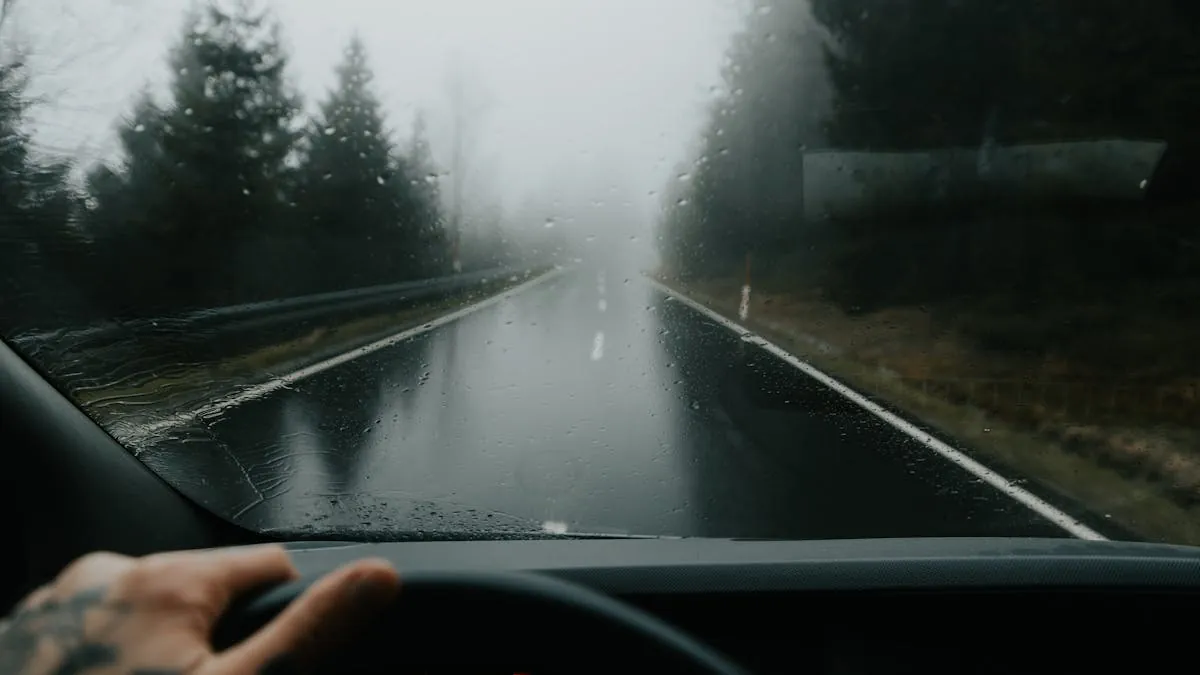
The single rule for fog is to slow down enough that you can stop within the distance you can actually see. Fog hides hazards until the last moment and usually comes with damp, slippery roads, so visibility and grip both matter. Use your lights correctly, keep your distance, and make sure your tyres are up to the conditions.
Drive to what you can see
In fog, your safe speed is whatever lets you stop within your visible distance. If you can only see 50 metres, you must be able to stop in less than that. The Highway Code puts it plainly in rule 235: be able to pull up well within the distance you can see clearly. This often means driving much slower than the limit, which feels frustrating but is the only safe approach when a stationary queue could appear out of the murk at any moment.
Using your lights correctly
Use dipped headlights in fog, always. The Highway Code (rule 236) says you must not use front or rear fog lights unless visibility is seriously reduced, which the code sets at below 100 metres, and you must switch them off when it improves, as they dazzle other drivers otherwise. Don't use full beam: the fog reflects the light straight back and makes it harder to see, not easier.
Fog means damp roads
Fog is suspended water, so the road surface is usually damp and grip is reduced, much like light rain, see wet-weather tyre safety. That means your braking and cornering grip depend on healthy tread and correct pressures just when you may need to brake suddenly for an unseen hazard. The legal minimum is 1.6mm across the central three quarters of the tyre, see UK tread depth law, but grip in the wet starts dropping well before that. Worn tyres and fog are a bad combination.
Don't hang on to tail lights
It's tempting to follow the tail lights of the car ahead to feel less alone in fog, but it pulls you too close and gives a false sense of safety, you're matching the speed of a driver you can't really see. Keep your own safe gap and your own safe speed regardless of what others are doing.
Before you set off in fog
Fog is the one condition where five minutes of preparation on the drive changes the whole journey. The Highway Code's rule 234 tells you to check your mirrors and slow down before entering fog; the practical checks below make sure you can actually see and be seen once you are in it.
- Clear every window inside and out. Fog means damp air, so the inside of the glass mists quickly. Run the heater and air conditioning together to dry the cabin, and wipe the inside of the windscreen before you move.
- Check all your lights work, including both rear fog lights if the car has two, the number plate lights and the brake lights. Walk round the car with the lights on.
- Find the fog light switch now, not at 50mph. On many cars it is a collar on the indicator stalk or a button by the headlight dial, and the dashboard shows a separate symbol for front and rear.
- Top up the washer fluid. Spray from other vehicles smears in fog and you will use the washers constantly.
- Look at the tyres. Damp roads and sudden braking are the fog combination, so tread and pressures matter.
- Allow extra time so you are not tempted to push on at a speed the visibility does not support.
If the forecast is for dense fog and the journey is not essential, the safest decision is the one made at home. That is not defeatist: multi-vehicle collisions in fog almost always involve people who could see less than they were driving to.
Junctions, motorways and fog patches
The two places fog catches drivers out are junctions, where you cannot see approaching traffic, and motorways, where fog comes in patches and speeds are high. Each needs a specific technique.
At junctions
Rule 235 of the Highway Code is explicit: at a junction with limited visibility, stop in the correct position, listen for traffic, and only emerge when you are sure it is safe. Winding the window down makes it easier to hear. Use your indicators early and, once you have pulled out, do not linger.
If you are waiting at a junction in fog, keep your foot on the brake so the brake lights warn anyone coming up behind.
On motorways and dual carriageways
- Fog often sits in dips, river valleys and low-lying stretches, so a clear patch is not a signal to speed up. Assume the next dip is full of it.
- Obey the overhead signs. A "FOG" warning or a reduced limit on the matrix signs is there because the control room can see what you cannot.
- Do not use the right-hand lane to get past slower traffic you cannot see. Stay in the left or middle lane with a large gap.
- Brake early and gently. The Highway Code notes that fog lights can obscure your brake lights, which is one more reason not to leave rear fog lights on in a clear patch and to give the driver behind time to react.
Fog, frost and black ice
Freezing fog leaves a thin layer of ice on the road that you cannot see, so treat any fog when the temperature is near freezing as an ice warning. Many cars flash a warning at about 4°C for that reason.
Bridges, exposed stretches, tree-lined lanes and the shaded side of hills freeze first, and a road that felt fine a mile ago can be glass at the next bend.
Three things follow from that:
- Brake earlier and lighter still. On ice, ABS will do its job, but no braking system shortens a stop below what the tyre can grip. Leave a gap that feels excessive.
- Steer gently. Sudden inputs unload the tyres. Look where you want to go, and if the car slides, ease off rather than adding more lock.
- Watch your pressures. Tyre pressure falls as the temperature drops, roughly 1 PSI for every 5 to 6 degrees of cooling, so a cold snap can leave all four tyres soft, see tyre pressure in cold weather.
Cold also changes what the tyre compound can do. Below about 7°C a summer tyre stiffens and grips less, which is why winter and all-season tyres exist.
If you regularly drive early mornings through low-lying, foggy country, a set of all-season tyres is a sensible, no-fuss upgrade. For the full technique on ice and snow, read driving in snow and ice.
If you break down in fog
A stationary car in fog is a hazard to everyone behind it, so get fully off the road if you possibly can and make the car visible. Highway Code rule 251 says not to park on a road in fog, and if it is unavoidable to leave your parking lights or sidelights on.
- On an ordinary road: hazards on, sidelights on, and get the car into a lay-by, side road or verge rather than stopping in the carriageway. Put the warning triangle out at least 45 metres behind on a non-motorway road if it is safe to do so. Get passengers out on the side away from traffic if you are on a fast road.
- On a motorway: do not use the triangle. Leave the car by the passenger side, get behind the barrier and up the bank if there is one, and call for help. If you are stuck in a live lane, stay belted in with the hazards on and dial 999. National Highways can be reached on 0300 123 5000, and their breakdown advice covers smart motorways and emergency areas.
Tell whoever you call that visibility is poor. A recovery driver approaching in fog needs to know they are looking for a car they may not see until they are on it. Give the marker post number or a what3words location rather than a landmark nobody can see.
We attend punctures and blowouts, including evenings, nights and weekends when the diary allows, but never on a motorway hard shoulder, slip road, verge or emergency area, where the only safe answer is recovery to a safe place first.
From a lay-by, a services car park or your own drive, we can fit a replacement on the spot, see emergency tyre replacement . Our guide to hard shoulder safety has the full motorway procedure.
Stay tyre-ready
Healthy tyres give you the grip to stop for what fog hides. We replace tyres at your home or workplace from our one base at Brent Cross, NW2. London and the Home Counties are closest; for anywhere further out we tell you on the call whether we can take the job, and the arrival time is given on the call.
