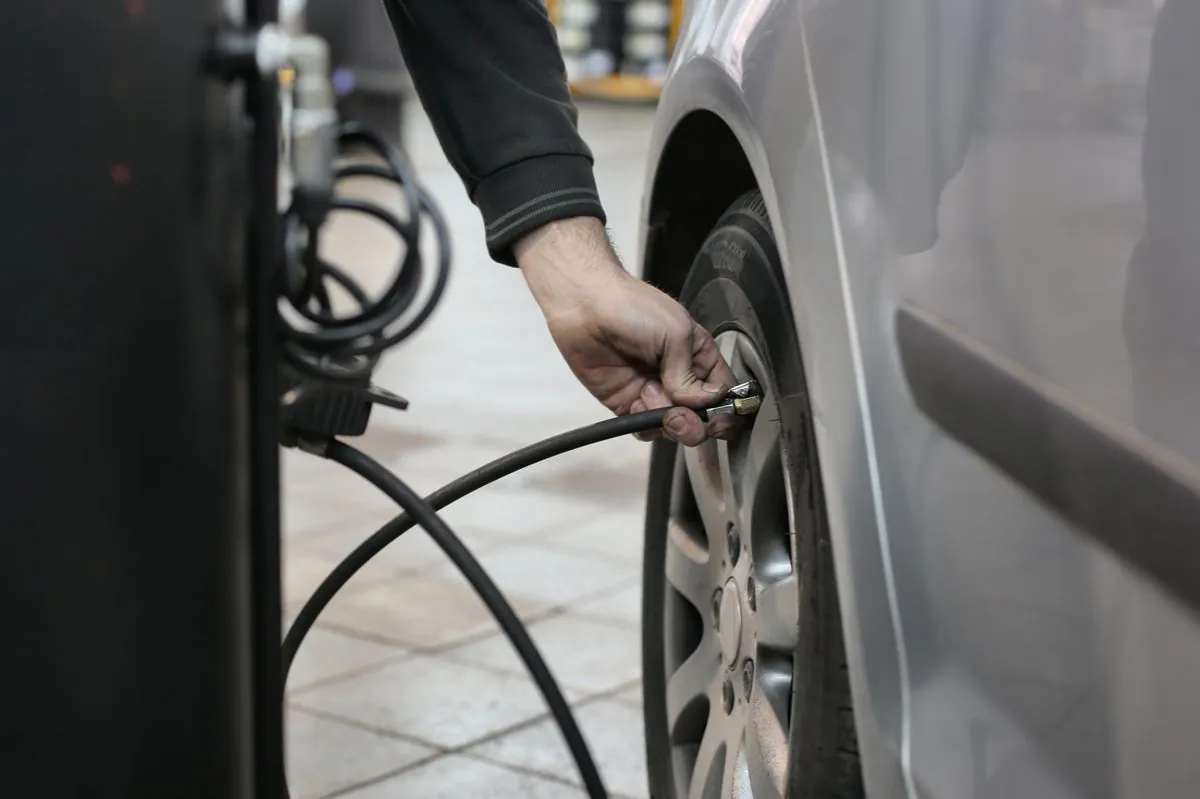
Set all four tyres to the pressures on the label in the driver's door pillar with the tyres cold, tell the car you have done it, then drive. On most 3 Series the reset is not a button to hold down but a confirmation you give the car from the driver's seat while it is stationary, through iDrive on newer cars or the on-board computer on older ones, and the system then finishes the job on the move.
The reason it works that way is that BMW has used two quite different systems. The Flat Tyre Monitor never measures pressure at all. It watches how fast each wheel is turning, because a tyre losing air gets slightly smaller and therefore spins faster than the others, so it has to be told what normal looks like and then taught it again on the move. The Tyre Pressure Monitor reads a sensor inside each wheel and reports real pressures, so a reset simply tells it that the pressures it can now see are the ones to treat as correct. TyreSafe's explainer on tyre pressure monitoring systems calls these two designs direct and indirect, and describes the indirect type as working from the ABS wheel speed sensors rather than from any pressure reading.
Which one your 3 Series has is not a straight question of age. BMW UK's wheels and tyres pages put it plainly: depending on the vehicle and year of manufacture, BMW uses an electronic tyre pressure indicator that shows you the tyre pressure on the display. That sentence is also the test. If your car can show you a pressure figure for each individual tyre, it has the sensor based Tyre Pressure Monitor. If it can only tell you the system is active, it has the Flat Tyre Monitor.
One thing this guide deliberately does not do is invent menu wording. BMW changed iDrive several times across the E90, F30 and G20, and the labels on screen move with the software version rather than with the badge on the boot. Where we could not confirm an exact menu path against BMW's own published handbook, we say so and send you to the handbook in your own car instead of guessing.
Which tyre pressure system does your BMW 3 Series have?
Settle this first, because it changes what the reset is actually doing and how much the car can tell you afterwards. The quick test needs no paperwork: open the tyre page on the display. Individual pressure readings for each corner mean the Tyre Pressure Monitor. A screen that only reports whether the system is active means the Flat Tyre Monitor.
| Generation | Roughly | What to expect | How to confirm on your own car |
|---|---|---|---|
| E90, E91, E92 and E93 (saloon, Touring, coupe, convertible) | 2005 to 2013 | Either system, and many cars of this age use the indirect Flat Tyre Monitor | Open the tyre page on iDrive or the on-board computer and look for per tyre pressure figures |
| F30, F31 and F34 | 2012 to 2019 | Either system, with the sensor based Tyre Pressure Monitor common on later cars | Same display test, then check the handbook for your build |
| G20 and G21 | 2019 onwards | Sensor based monitoring shown on the iDrive screen | The tyre page should name each tyre and give it a pressure |
Be careful with that table. The years are the generations as sold in the UK, but the system column is what to expect rather than a guarantee, and we have not been able to confirm a 3 Series fitment table against BMW's own published owner's handbook for this article. BMW's own wording, that it depends on the vehicle and year of manufacture, is the honest position. The display test is worth more than any list, because it describes the car sitting on your drive.
There is one hard date that does apply to every 3 Series. TyreSafe notes that all new cars are now fitted with a tyre pressure monitoring system, and the DVSA MOT inspection manual brings the system into the MOT for M1 vehicles first used on or after 1 January 2012. That takes in the last of the E90 family as well as every F30 and every G20. Our general explainer on what the TPMS warning light means covers the two designs in more depth.
Pressures first: what to set before the iDrive reset
Whichever system your 3 Series has, the reset stores the current state of the tyres as its reference. Reset with one tyre soft and you have taught the car that soft is normal, which is worse than leaving the light on, because now nothing will warn you. So the air comes first, every time.
- Where the figures are. BMW UK tells owners to check the tyre pressure for the approved tyre sizes on the B pillar with the driver's door open. That label is the reference for your car, your wheel size and your load.
- Cold means cold. Pressure rises as a tyre heats up, so a reading taken straight after a run flatters the tyre. TyreSafe says pressures should be checked manually when they are cold, at least once a month or before a long journey, and is clear that a monitoring system should not replace those manual checks.
- All four, not just the one that warned. An indirect system compares wheels against each other, so one odd tyre out of four is exactly what confuses it.
- Check the valves while you are there. A perished or corroded valve leaks slowly and brings the light straight back.
- Put the caps back on. On a sensor equipped car the cap protects the valve stem that the sensor lives in, which is not a part you want to lose to salt.
No pressure figures appear in this article on purpose. They change with tyre size, wheel size and how heavily the car is loaded, so take them from your own label rather than from the internet.
Where does the tyre pressure reset sit in iDrive?
The shape of the job is the same on every 3 Series that has a screen, and it is worth knowing the shape even if the wording on your car differs:
- Correct all four tyres cold, and put the caps back on.
- Sit in the car, stationary, with the engine running or the car in its drive ready state. The reset is never started while moving.
- Open the tyre monitoring page. On iDrive cars it sits in the vehicle information or vehicle status part of the menu, next to the other status screens.
- Choose the option that confirms the current pressures as the ones to remember.
- Drive off normally. Both systems complete the reset on the move, not on the driveway.
That last step catches people out more than any other. The warning lamp often stays lit for the first part of the drive, because an indirect system needs to relearn how far each wheel travels per turn and a sensor based system needs a few minutes of running before it accepts the new figures. A light that has not gone out by the end of the road has not necessarily failed.
What we are not going to print is a click by click path for each generation. BMW ran several versions of iDrive across these cars, the labels changed part way through model runs, and a software update at a service can change them again. We could not verify BMW's exact on screen wording for the E90, F30 and G20 against BMW's own owner's handbook while writing this, so the reliable source is the handbook supplied with your car, or the digital handbook BMW provides for your vehicle. Menu wording invented from memory is how people end up resetting the wrong thing.
How does the reset work on an E90 (2005 to 2013)?
The E90 family is the awkward one, because it spans the arrival of iDrive in this class. Some cars have the rotary controller and a proper central screen, some have a much simpler on-board computer read through the instrument cluster and the buttons on the stalk or steering wheel, and the tyre page lives in a different place on each. We could not confirm from BMW's own handbook which control your particular E90 uses, so check the handbook rather than hunting through menus at the roadside.
What is certain on a car of this age is the mechanical side, and that is where the problems usually are:
- An indirect system has to be reinitialised after any change. New pressures, a different load, a wheel swap front to back or a new tyre all change the reference, so the reset is not optional housekeeping.
- A space saver breaks it. A temporary spare is a different diameter, so a system that works by comparing wheel speeds has nothing valid to compare and cannot protect you until the proper wheel is back on.
- Slow leaks are common. Fifteen year old valves, corroded rims and old alloys that have met a few potholes all leak gently. Pothole damage and a buckled alloy both show up as a tyre that will not hold pressure with no puncture to find.
- An indirect system cannot see gradual loss on all four. If every tyre goes down together over a winter, nothing on the dashboard will mention it. That is exactly why TyreSafe insists the monitor does not replace a monthly check with a gauge.
If your E90 was first used on or after 1 January 2012, which takes in the last of the Touring, coupe and convertible cars, the MOT tester will treat a monitoring system that is malfunctioning or obviously not working as a major defect, per the DVSA MOT inspection manual.
How does the reset work on an F30 (2012 to 2019)?
Every F30 has a central display and the iDrive controller on the transmission tunnel, so the reset is done on screen. The tyre monitoring page sits with the other vehicle status screens, you confirm the pressures there with the car stationary, and the car finishes the reset once you are moving.
The complication is that the F30 ran for seven years across more than one version of iDrive, including a significant redesign of the screens part way through. A 2013 car and a 2018 car do not read the same, and cars of the same year can differ by specification. We could not verify BMW's exact labels for each of those software versions against BMW's own handbook, so use the handbook for your car rather than a path copied from a car that looks like yours.
The F30 is also the generation where the display test matters most, because a UK car of this age can genuinely have either system. It is worth knowing which you have before anything goes wrong:
- With the Tyre Pressure Monitor, the car can normally tell you which tyre is low and by roughly how much, so you know before you get out whether you are looking for a nail or a slow drift across all four.
- With the Flat Tyre Monitor, the car can only tell you that something has changed. Everything after that is you, a gauge and four tyres.
Either way, reset again after a tyre change, after moving wheels around the car, and after swapping between a summer and a winter set. A set of winter wheels on a sensor equipped car needs its own sensors, which is a real consideration rather than an afterthought, and our guide to TPMS sensor replacement explains why.
How does the reset work on a G20 (2019 onwards)?
The G20 is the most straightforward of the three to live with, because it reads real pressures and shows them to you. The tyre page sits in the vehicle section of iDrive alongside the other status screens, the reset is confirmed there with the car stationary, and the car adopts the new figures after a few minutes of driving.
Two things about the readings confuse owners more than the reset itself:
- The numbers move, and that is normal. Pressure rises as the tyres warm up, so a figure above the door pillar label after a motorway run is the system working properly, not a fault. Compare against the label only when the tyres are cold.
- Cold mornings do the opposite. Pressure falls as temperature falls, which is why these lights appear on the first properly cold morning of the year. BMW's own tyre pages treat 7 degrees Celsius as the point where cold weather tyres start to earn their keep.
As with the other generations, we have not printed the exact menu labels here. The G20 has already been through more than one major iDrive version, and software updates change wording, so the handbook for your car and its current software is the only source worth trusting on that. What does not change is the order: correct the pressures first, confirm second, drive third.
One G20 specific point is worth adding. Because the car names the tyre, a warning that keeps naming the same corner is telling you something useful. That is a slow puncture until proven otherwise, and it deserves a proper look rather than another top up.
What does a run-flat actually do about a puncture on a 3 Series?
A lot of 3 Series wear run-flats and carry no spare wheel, which changes what the warning light means. It is the difference between a tyre that goes soft and tells you by handling badly, and a tyre that goes soft and tells you only through the dashboard.
Here is what a run-flat does, from the safety bodies rather than from the marketing:
- TyreSafe's guide to run flat tyres describes self supporting run-flats as designed to provide a limited run on period following a puncture. Tyres marked with the letters RF in the size marking are able to run uninflated for at least 50 miles at a maximum speed of 50 mph. Tyre makers also use their own codes on the sidewall, so check the tyre or ask before you assume.
- BMW UK puts the same point the other way round: run-flats let you continue driving for a certain distance after a flat, whereas a conventional tyre needs replacing as soon as you get one.
- TyreSafe is emphatic that a working tyre pressure monitoring system is essential alongside run-flats, because the tyre no longer announces itself. Without it a driver can be left in ignorance of a deflated tyre and run it far longer than the tyre was designed to take.
Now the part people skip. A run-flat does not repair anything. The nail is still in the tread, the tyre is still losing or has already lost its air, and the stiff sidewall is doing a job it was never designed to do repeatedly. Fifty miles at 50 mph is a ceiling for reaching somewhere safe, not a plan for the week, and it assumes a reasonable load and a reasonable road. A run-flat that has been driven on with little or no pressure can have internal damage you cannot see from the outside, so it needs inspecting before anyone talks about repairing it. What can and cannot be repaired is set by where the damage sits and by the British Standard BS AU 159, and our guide to whether a puncture can be repaired sets out those rules. Our guide to whether run-flat tyres can be repaired covers the repair limits and how far you can drive on one.
Two more things TyreSafe is firm about: do not mix run-flats and conventional tyres on the same car, and do not retrofit run-flats to a car that was not designed for them, because the suspension is tuned around the tyre. If your 3 Series left the factory on run-flats, that is what it should stay on unless the change is done properly across the car.
If the alternative on offer is a can of sealant, bear in mind that sealant and pressure sensors do not always get along. On a motorway, do not stop to look at a tyre: if the car still handles normally, leave at the next junction or services; if it does not, stop in an emergency area or as far to the left as you safely can, get everyone out behind the barrier, and call National Highways on 0300 123 5000, or 999 if anyone is in danger.
Steady, flashing or back within days: reading the lamp
Start with what the lamp is doing, because a steady light and a flashing one are different problems.
| What you see | What it usually means | What to do |
|---|---|---|
| Steady light, first few miles after a reset | The system has not finished learning yet | Keep driving normally and give it a proper run |
| Steady light that returns within days of a correct reset | A tyre is still losing air | Treat it as a slow puncture and have it found |
| Lamp flashes a number of times, then stays on | A system malfunction rather than a soft tyre | Have the system checked, and keep using a gauge meanwhile |
| Light on with a space saver or an odd wheel fitted | The system cannot monitor a wheel it does not recognise | Expect it until the proper wheel is back on, then reset |
That flashing behaviour is not folklore. The DVSA MOT inspection manual describes it directly: the lamp may flash a number of times and then remain on in the event of a system malfunction, and the same manual notes that a lamp which simply stays on after a previous pressure loss does not automatically mean the system is faulty. The same section lists a tyre pressure monitoring system malfunctioning or obviously not working as a major defect for cars first used on or after 1 January 2012.
On a sensor equipped 3 Series, a fault that no amount of resetting will clear is usually the sensor itself. TyreSafe points out that the sensors carry an internal battery that eventually runs out, and that they can fail through weather damage, corrosion or accidental damage while a tyre is being changed. That is a replace and match job rather than a reset.
If the light is steady, came back within days and the system is otherwise healthy, believe the car. A nail or screw in the tread, a leaking valve or a poor seal between tyre and rim all produce exactly that pattern, and topping the tyre up again only delays the conversation.
When a reset will not fix it
Reset the light yourself when the pressures were simply low and nothing else looks wrong. Get someone out to the car instead if:
- the tyre is a run-flat that has already been driven on with little or no pressure
- the tyre is too soft to drive on safely and there is no spare in the boot, which is most 3 Series on run-flats
Rescue Tyres repairs and replaces tyres at the car from one base at Brent Cross, NW2; repairs follow BS AU 159, and if the fault is the monitoring system rather than the tyre we will tell you.
Phone or WhatsApp 07473 720871, or book online. There is more on how it works on our mobile tyre fitting page.
