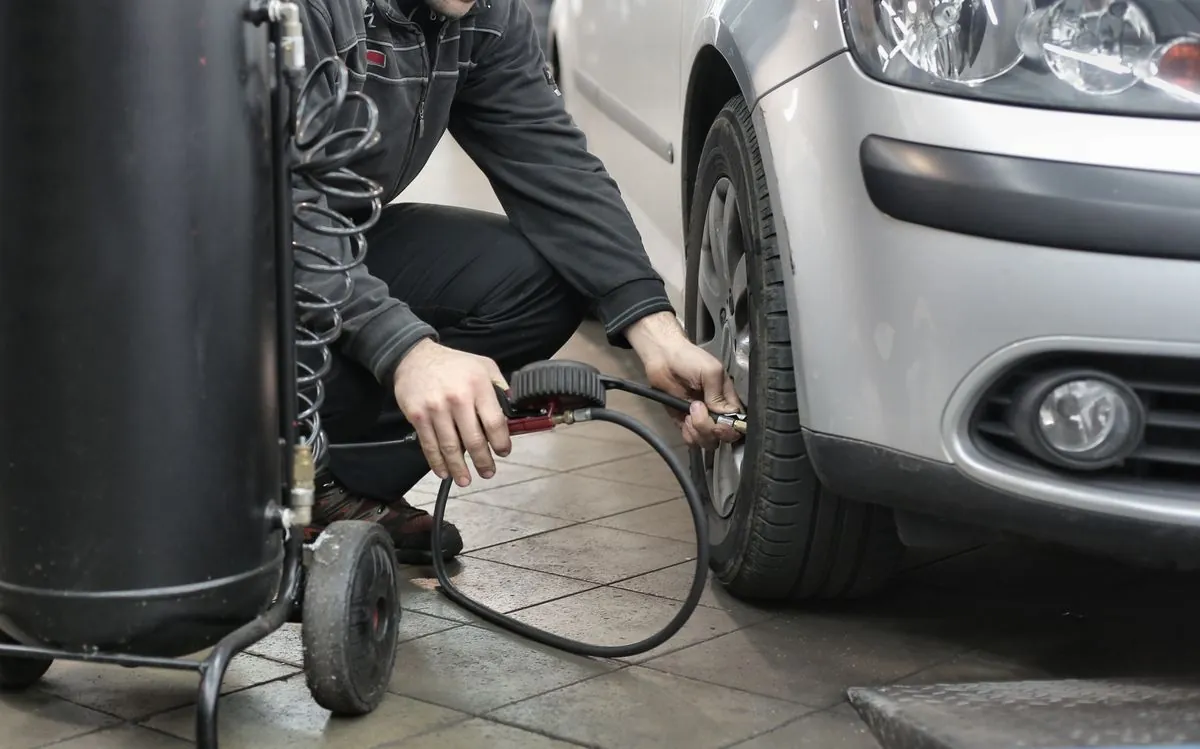
A Volkswagen Polo will not clear its own tyre pressure warning. You set all four tyres to the correct cold pressures, then tell the car to store those pressures as its new reference, and only then does the lamp go out. Volkswagen's own UK guidance for the tyre pressure monitoring warning light reduces the job to one sentence: check and if necessary adjust the tyre pressure on all wheels, then store the tyre pressures using the menu display or by pressing the set button.
It is the word store that trips people up. Pumping the tyres back up fixes the tyres. It does not tell the car anything. Until you store the new figures, the Polo carries on comparing today's wheels against numbers it learned the last time somebody did that, which on a used car might have been years and two sets of tyres ago.
Two other things are worth saying before the steps. The Polo has not carried the same system throughout its life, and on the older cars it was not even fitted to every trim, so the first question is not how to reset it but whether your Polo has one. And the exact wording on the screen depends on which infotainment unit your car was built with rather than on the year alone, so where a Polo specific menu name cannot be confirmed from Volkswagen, this guide says so instead of inventing one. Volkswagen hands out the right handbook for your car by registration or VIN on its owner's manuals page, and on any point of detail your handbook wins.
Which tyre pressure system does your Polo have?
That depends on how old it is, and on a pre 2014 car it depends on the trim as well. Volkswagen's own UK price lists and brochures give a clear trail, and they do not use the same name twice.
| Polo generation | UK model years | What Volkswagen UK called it | Fitted to every car? |
|---|---|---|---|
| Mk6 (AW), including the 2021 facelift | Late 2017 onwards | Tyre pressure monitoring system | Yes, listed in the standard equipment of the entry model |
| Mk5 facelift (6C) | About 2014 to 2017 | Tyre pressure loss indicator | Yes, listed as standard |
| Mk5 (6R) | About 2009 to 2014 | Tyre pressure indicator | No, part of the optional Sensor pack on most trims |
| Mk4 (9N and 9N3) and older | Before 2009 | Not verified here | Check your own handbook |
The sources for that table are Volkswagen's, not ours. The launch price list for the current car, effective from 3 October 2017, puts a tyre pressure monitoring system in the standard equipment of the entry level Polo, which means every UK Mk6 has one. The 2015 Polo price list lists a tyre pressure loss indicator as standard on the facelifted Mk5. Go back to the 2010 Polo brochure and the picture changes: there the tyre pressure indicator is sold as part of an optional Sensor pack, standard only on BlueMotion, SEL and GTI. So a plain 2011 Polo S may genuinely have no system at all, and a warning lamp you have never seen is not a lamp that has broken.
Does the change of name mean the hardware changed? Not necessarily, and a brochure is not the place to settle it. There is a quicker test you can do sitting in the car. As TyreSafe explains in its guide to tyre pressure monitoring systems, a direct system uses a radio sensor inside each wheel to measure pressure, while an indirect one uses the existing ABS sensors to watch how fast each wheel is turning. A direct system therefore has a real number to show you. If your Polo's display can give you a pressure reading for each individual wheel, it has sensors in the wheels. If all it can do is warn you and offer to store the current pressures, it is the indirect kind, and storing is the whole reset. Our explainer on what the TPMS warning light means goes through both designs.
Is the Polo's reset a button or a menu?
Volkswagen names two routes and leaves it to you to know which one your car has: the menu display, or a set button. On a Polo the practical answer is that the older the car, the more likely it is to be a physical button, and the newer it is, the more likely the option sits inside the infotainment screen.
Three ways to find yours without guessing:
- Use the handbook index. Look up tyre pressure monitoring, or tyre pressure loss indicator, in the index of the handbook for your own car. That entry is the only Polo specific instruction that is guaranteed to match the equipment you actually have.
- Look for a small marked button. Where a set button exists it is usually close to the driver, near the gear lever or the base of the centre console, rather than out of reach. Your handbook will name it.
- Look in the vehicle settings, not the radio settings. Where the reset is on screen it sits with the car's own functions rather than with audio or phone.
We have deliberately not printed a menu path here. Volkswagen's public UK material does not spell one out for the Polo, and the Polo has shipped with several different infotainment units, so a sequence copied from a video of somebody else's Volkswagen may simply not exist on your screen. Following the wrong path wastes an afternoon. Reading one line of your own handbook does not.
What do you need to get right before you press anything?
The pressures themselves, because the reset copies whatever it finds. Store the pressures while one tyre is soft and you have not cleared a warning, you have taught the car that soft is the new normal, and the next real puncture has that much further to fall before anything lights up.
- Check them cold. TyreSafe's advice is to check pressures manually when the tyres are cold, at least once a month and before any long journey. A reading taken after a run up the M1 will look higher than the tyre really is.
- Read the figures off the car, not off the internet. TyreSafe points drivers to the vehicle handbook, the inside of the fuel filler flap or a placard in a front door sill. A Polo's correct pressures change with wheel and tyre size, so a GTI on its larger alloys and an entry level Polo on small wheels are not asking for the same number.
- Match the load. The placard normally gives more than one set of figures, one for a light load and one for a fully loaded car. Pick the row that matches how the Polo is being used this week.
- Do all four. An indirect system compares the wheels with each other, so three correct tyres and one guess is exactly the situation it is built to complain about.
We have not quoted any pressure figures on purpose. There is no single Polo number. If you want the background, see our correct tyre pressure guide.
How do you actually clear the light on a Polo?
Volkswagen's own UK instructions for the lamp are a short loop, and they are worth following in order rather than pressing things hopefully.
- Check and if necessary adjust the tyre pressure on all wheels, with the tyres cold.
- Store the tyre pressures, using the menu display or by pressing the set button, whichever your Polo has.
- See whether the light has gone out. If it has, carry on driving and keep checking the pressures regularly.
- If it has not, check all the tyre pressures again. If they are all correct, store them again. If they are not, Volkswagen's guidance is to have the tyre repaired or replaced rather than to keep resetting.
- If the light is still on after that second attempt, Volkswagen says to drive carefully to an authorised repairer and have the system examined.
Two things that follow from how an indirect system works. First, it learns while the car is moving, so a lamp that is still lit in the driveway has not necessarily failed to reset, and Volkswagen's own flow expects you to drive and then look again. Second, the system has nothing to compare against while it is relearning, so the days after a reset are the worst possible days to skip a manual check with a gauge.
What does it mean if the light flashes instead of staying on?
A flash usually means the system, not the tyres. Volkswagen's UK warning light guide describes the fault case precisely: the indicator lamp flashes for about a minute and then remains lit up in amber, which it puts down to a system fault. Its advice is blunt. Do not drive on, switch the ignition off and then back on again, re-synchronise the tyre pressure loss indicator, and if the fault persists go to a qualified workshop.
A lamp that simply comes on and stays on is the other message. Volkswagen describes that as a loss of pressure in one or more tyres, or a tyre that is structurally damaged, and tells you to check and adjust all tyre pressures, replace damaged tyres, and re-synchronise the system afterwards.
Both of those descriptions come from Volkswagen's general UK warning light guide rather than from a Polo specific page, so read them alongside your own handbook rather than instead of it.
| What the lamp does | What it is telling you | What to do first |
|---|---|---|
| Comes on and stays on | Pressure loss in one or more tyres, or a damaged tyre | Stop somewhere safe, check all four with a gauge, look for the damage |
| Flashes for about a minute, then stays on | A fault in the system itself | Ignition off and on, re-synchronise, then a workshop if it returns |
| Comes on and goes off again on its own | A tyre near the warning threshold, often after a cold night | Check it cold with a gauge before you trust it |
That flash then stay pattern is not a Volkswagen quirk. The DVSA MOT inspection manual describes the same behaviour in general terms, noting that in the event of a system malfunction the lamp may flash a number of times and then remain on, and that a lamp which is simply lit because of an earlier pressure loss does not automatically mean the system has a malfunction.
What if your Polo has no tyre pressure system at all?
Then there is nothing to reset, and no amount of menu hunting will produce a reset that was never built. This is a real situation on the Mk5 Polo of 2009 to 2014, where Volkswagen's own brochure sold the tyre pressure indicator inside an optional Sensor pack and made it standard only on BlueMotion, SEL and GTI. Plenty of Polos of that age left the factory without it.
The timing is not an accident. TyreSafe records that the legislation began on 1 November 2012, when all new car models sold in the EU had to have a tyre pressure monitoring system, and was broadened in November 2014 to cover every new passenger vehicle being sold. That is the same window in which the facelifted Polo's price list starts listing the tyre pressure loss indicator as standard rather than as an option.
If your Polo has no system, the job reverts to the thing that never stopped being necessary: a gauge, once a month, cold, plus a look at the tread and sidewalls while you are down there.
Why does the light come back a few days after a reset?
Because the air is still going somewhere. A reset does not seal anything. If the lamp was honest the first time, clearing it only resets the clock on the same leak, and the possible causes on a Polo are the same as on any other car.
- A slow puncture. A screw or a flint picked up on the road can seal itself well enough to lose only a little air a day, which is exactly the rate an indirect system takes a while to notice. Our guide to slow puncture causes and fixes explains how to find one.
- The valve. Valves perish, corrode and leak at the base, and a leaking valve looks identical from the driver's seat to a leaking tyre.
- The rim seal. Kerbed alloys and corroded rims let air past the bead, which typically shows up as one wheel that always needs topping up.
- The weather. Air contracts as it cools, so the first proper cold snap sets off a great many lamps on tyres that were only marginally low to begin with.
- A failed sensor. Only relevant if your Polo has sensors in the wheels. Their batteries do not last forever, and a replacement usually has to be matched to the car with diagnostic equipment, as our guide to TPMS sensor replacement explains.
A useful rule of thumb: if the lamp returns within a week of a correct reset, treat it as a leak until somebody proves otherwise.
Is it safe to keep driving a Polo with the light on?
Volkswagen's answer is no. Its guidance for both the low pressure lamp and the system fault lamp says do not drive on, and the reasoning is sound. An under inflated tyre runs hot, flexes where it is not designed to flex and can fail suddenly, and a car with a faulty monitoring system cannot warn you when the next one starts going down.
- On a motorway, do not stop on the carriageway to look at a tyre. If the car handles normally, slow down, leave at the next junction or services and check it there; if not, pull onto the hard shoulder or into an emergency area, leave by the left-hand door and wait behind the barrier. If you are in danger, call 999. National Highways can be reached on 0300 123 5000.
- Stop sooner if the steering has gone heavy or vague, if you can hear a rhythmic flapping or rumble, or if a tyre is visibly soft. Driving on a flat destroys the sidewall quickly and turns a repairable puncture into a new tyre.
- With a flashing lamp, assume you have no warning system at all until it is fixed, and check all four by hand more often than usual.
There is an MOT angle too. The DVSA inspection manual applies the tyre pressure monitoring check to M1 vehicles first used on or after 1 January 2012, which takes in every Mk6 Polo and the later Mk5s, and it lists a tyre pressure monitoring system that is malfunctioning or obviously not working as a major defect. A lamp that is lit only because a tyre is low is a different matter, and it is one you can put right before the test.
When should you get a mobile fitter out to your Polo?
When the reset is not the problem. Call somebody out rather than reaching for the pump again if:
- the warning returns within days of a correct reset
- one tyre is always the one that needs air
- you can see a screw, a nail, a cut or a bulge
- the lamp flashes, or refuses to clear after new tyres or a wheel swap
- the tyre is too soft to drive on safely
If the light keeps coming back, a fitter can come to the Polo at home, at work or wherever it is safely and legally parked off the main road, check all four pressures against the figures on your own car, inspect the tread, sidewalls and valves, and carry out puncture repairs to BS AU 159 where the damage falls inside the repairable area.
When you call, say which generation your Polo is and whether the lamp is steady or flashing; that tells us whether it is more likely to be a tyre or the system.
