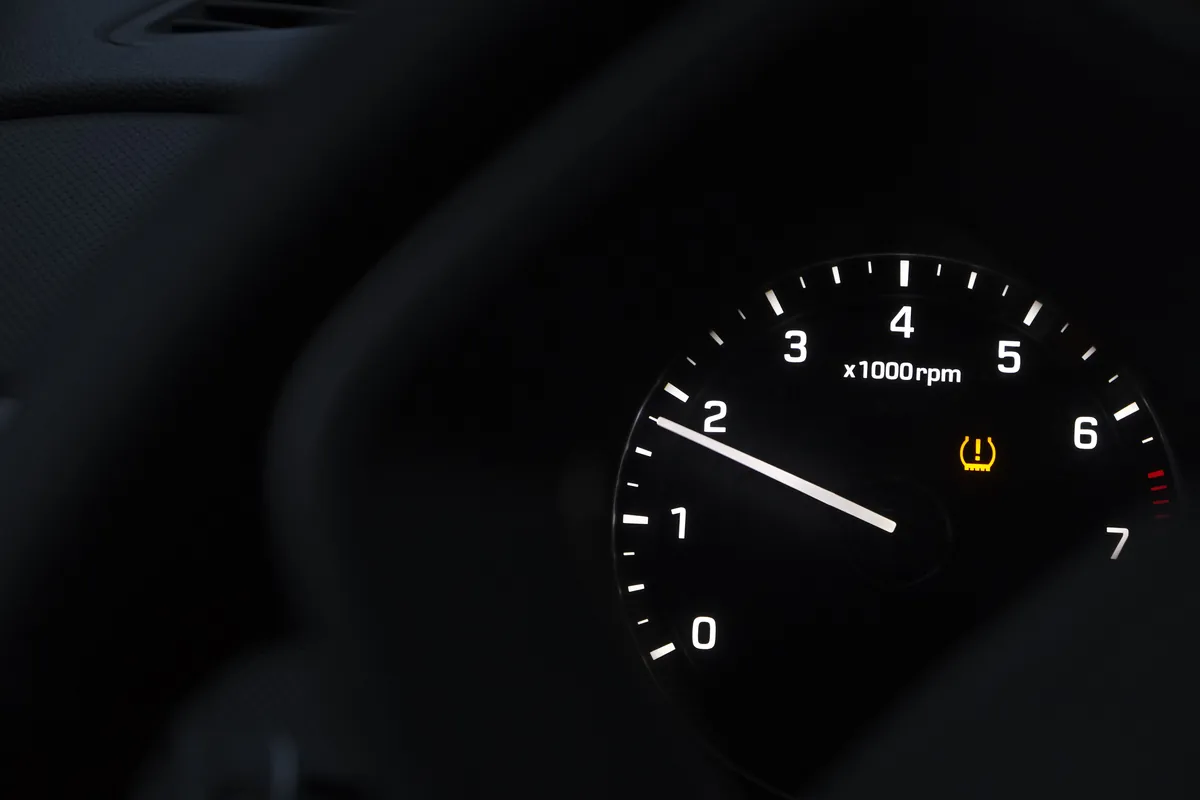
To clear the tyre pressure warning on a Mercedes A-Class, set all four tyres cold to the pressures in the tyre pressure table on the inside of the fuel filler flap, then restart the system from the Service menu in the instrument display and drive the car so it can adopt the new values. There is no reset button and no hidden sequence of pedal presses. On every A-Class the restart is a menu item, and the exact wording of that menu depends on which of two systems Mercedes fitted to your car.
This guide covers the W176 A-Class sold from late 2012 to 2018 and the W177 A-Class sold from 2018 onwards, the generation with the MBUX screens. Every step and every message quoted below is taken from Mercedes-Benz's own owner's manuals, and the edition is named each time so you can check it against your own car. Mercedes publishes the current manuals on its owner's manuals page, and older editions as downloadable PDFs. If your screen wording differs from what you read here, follow your own manual rather than guessing.
Which tyre pressure system does your A-Class have?
Mercedes does not fit one system to the A-Class. Its manuals describe two, with two different names, and the restart is different for each. Before you touch a menu it is worth knowing which one you are looking at.
| System name used by Mercedes | How it works | What you see on screen | Restart wording |
|---|---|---|---|
| Tyre pressure monitoring system | A tyre pressure sensor in each wheel | A pressure, and on the W177 a temperature, for each individual wheel | Use current tyre pressures as new reference values? |
| Tyre pressure loss warning system | Compares how fast each wheel is turning | Run Flat Indicator active | Are the current pressure values OK? |
The W177 manual describes the sensor system plainly: it "checks the tyre pressure and the temperature of the tyres fitted to the vehicle by means of a tyre pressure sensor", and those values are shown on the driver display. The other system never measures pressure at all. The W176 manual explains that while the vehicle is in motion the tyre pressure loss warning system "monitors the set tyre pressure using the rotational speed of the wheels", because a tyre that loses air gets slightly smaller in diameter and therefore turns faster than the others.
So the quickest test is to open the Service menu in the instrument display and look at what appears. A pressure figure for each corner means the sensor system. The words Run Flat Indicator active mean the wheel speed system. That single difference decides which set of steps below applies to your car, and it matters more than the model year does. Our explainer on what the TPMS warning light means goes into the engineering difference between the two designs in more detail.
One consequence is worth noting now. Because the wheel speed system has no sensors, fitting a different set of wheels never upsets it. The sensor system is the opposite: every wheel on the car has to carry a working sensor, or the system switches itself off. That is why an A-Class warning can refuse to clear after new wheels or a winter set.
Before any reset: getting the A-Class pressures right
A restart does not fix anything on its own. Both Mercedes systems take whatever the tyres are currently set to and store that as the new reference. Restart with one soft tyre and you have simply taught the car that soft is normal. The W176 manual says it directly: the system "can only give reliable warnings if you have set the correct tyre pressure. If an incorrect tyre pressure is set, this incorrect value will be monitored."
- Where the figures live. Both the W176 and W177 manuals say the tyre pressure table is on the inside of the fuel filler flap. It gives different pressures for different load conditions, described in the W177 manual as partially laden and fully laden, and sometimes different pressures for different tyre sizes, so read the row that matches your wheels and your load.
- Cold means genuinely cold. The W177 manual defines cold tyres as a vehicle that "has been parked with the tyres out of direct sunlight for at least three hours" and "has travelled less than 1.6 km". Anything warmer reads high.
- How much temperature moves it. The W176 manual puts the change at roughly 10 kPa, which is 0.1 bar or about 1.5 psi, for every 10 degrees Celsius. That is enough to explain most lights that appear on the first cold morning of autumn, as we cover in our guide to tyre pressure in cold weather.
- How often to check. The W176 manual asks owners to check the tyre pressure regularly, at least every 14 days. The W177 manual sets out a slightly different list: monthly, when the load changes, before a longer journey, and when the operating conditions change.
- Use a gauge, not your eyes. Both manuals say the outward appearance of a tyre gives no reliable indication of its pressure. TyreSafe's guidance on tyre pressure makes the same point for UK drivers.
No pressure figures appear in this article on purpose. They vary by engine, wheel size and load across the A-Class range, so the only correct source is the table on your own car.
One more detail from the W177 manual that catches people out: the pressures shown on the driver display "may deviate from those of the tyre pressure gauge as they relate to sea level". At altitude a gauge reads higher than the screen does, and the manual says not to let air out to make the two agree.
How to restart the system on a W177 A-Class (2018 onwards)
On the W177 the restart lives in the Service menu of the driver display, the instrument screen in front of you, and you drive that menu with the Touch Control on the left-hand side of the steering wheel rather than the central MBUX screen. Swipe sideways on that Touch Control until the Service menu is shown, then press it to open the menu. The A-Class owner's manual, April 2024 edition lists Tyre pressure as one of the items on that menu. In the steps below that manual writes each press as OK, which on this car is the Touch Control pressed inwards rather than a separate button.
If your car has the tyre pressure monitoring system, the manual gives these steps once all four pressures are correct for the current operating condition:
- In the driver display, open the Service menu.
- To show the tyre pressures, press OK.
- To show the options, press OK again.
- Select Tyre pressure and confirm with OK.
- The driver display shows the message "Use current tyre pressures as new reference values?".
- Select Yes and confirm the restart with OK.
The display then shows "Tyre pressure monitor restarted". The manual says current warning messages are deleted and the yellow warning lamp goes out at that point, but the job is not finished. After you have driven for a few minutes the system checks whether the current pressures are within the specified range, and only then accepts them as reference values. If they are not, the message "Please correct tyre pressure" appears, which is the car telling you the tyres were wrong when you restarted it.
If your car has the tyre pressure loss warning system, the same 2024 manual gives a different sequence:
- In the driver display, open the Service menu.
- Select Tyre pressure and confirm with OK. The display shows "Run Flat Indicator active".
- To start the restart, press OK. The display shows "Are the current pressure values OK?".
- Select Yes.
- To confirm the restart, press OK. The display shows "Run Flat Indicator restarted".
Early W177 cars are worth a separate word, because Mercedes has reworded these menus over the life of the model. The June 2018 edition of the same manual describes the path as Service then Tyres on the on-board computer, and asks you to "swipe downwards on Touch Control on the left-hand side of the steering wheel" before pressing it to begin the restart, with the confirmation question phrased as "Tyre pressure now OK?". The buttons and the logic are identical. Only the labels moved. That is exactly why it pays to open the PDF for your own car's edition rather than copying a sequence from a video.
Both manuals say when a restart is required: the tyre pressure has changed, or the wheels or tyres have been changed or newly fitted. If you have just had a puncture repaired or a new tyre fitted, that is your cue.
How to restart the system on a W176 A-Class (2012 to 2018)
The W176 has no touchpads on the steering wheel. You drive the multifunction display with the arrow buttons on the left-hand side of the wheel instead, and the menu is abbreviated on screen as Serv. The steps below come from the A-Class owner's manual, January 2017 edition.
Tyre pressure loss warning system. With the pressures already set correctly on all four tyres:
- Make sure the key is in position 2 in the ignition lock.
- Use the left and right buttons on the steering wheel to select the Serv. menu.
- Use the up and down buttons to select Tyre pressure.
- Press the OK button. The display shows "Run Flat Indicator active Restart with OK".
- Press OK again. The display shows "Tyre press. now OK?".
- Select Yes with the up or down button, then press OK. The display shows "Run Flat Indicator restarted".
The manual adds that after a teach-in period the system will monitor the set tyre pressures of all four tyres, so the car is still learning for the first few miles. If you change your mind part way through, pressing the back button, or selecting Cancel at the "Tyre press. now OK?" prompt, leaves the previously stored values in place.
Tyre pressure monitor. On a W176 fitted with sensors the navigation is the same but the prompt is different. After selecting Tyre pressure and pressing OK, the display shows either the current pressure for each tyre or the message "Tyre pressures will be displayed after a few minutes of driving". Press the down button and the display shows "Use current pressures as new reference values". Press OK to confirm and the display shows "Tyre press. monitor restarted". The manual notes that in most cases the system detects the new reference values by itself after a pressure change, and this manual restart is there for when it does not.
Two W176 messages tell you a restart is overdue rather than optional. "Check tyre pressures then restart Run Flat Indicator" means the tyre pressure loss warning system raised a display message and has not been restarted since. "Rectify tyre pressure" means the pressure is too low in at least one tyre or the difference between wheels is too great, and the manual's instruction is to check the pressures at the next opportunity, correct them, and restart the tyre pressure monitor.
Yellow warning lamp, or a message saying the system is unavailable?
This is the distinction that decides whether you have a tyre problem or a system problem, and both A-Class generations behave the same way. The yellow tyre pressure symbol has two states, and they mean opposite things.
| What you see | What the Mercedes manuals say it means | What to do |
|---|---|---|
| Yellow lamp lit steadily | Pressure loss detected in at least one tyre. The system is working. | Stop safely, check the tyres, correct the pressures, then restart the system |
| Yellow lamp flashes for about one minute then stays lit | The tyre pressure monitoring system is malfunctioning | The manual says consult a qualified specialist workshop |
| "Tyre press. monitor inoperative" | The system is malfunctioning and "cannot issue a warning if there is pressure loss in one or more of the tyres" | Have it checked, and check pressures by hand meanwhile |
| "Tyre pressure monitor inoperative No tyre pressure sensors" | The wheels fitted do not have suitable sensors, so the system is deactivated | Fit wheels with suitable sensors |
| "Tyre press. monitor currently unavailable" | Interference from a powerful radio signal source is blocking the sensor signals, so the system is temporarily unavailable | The manual says drive on. It restarts itself once the cause has gone |
| "Wheel sensor(s) missing" | No signal from the sensor in at least one wheel, so no pressure is shown for that tyre | Have the faulty sensor replaced |
| "Run Flat Indicator inoperative" | The tyre pressure loss warning system is malfunctioning | Consult a qualified specialist workshop |
The practical reading is simple. A steady lamp is about air. A flashing lamp, or any message ending in the word inoperative, is about the system, and while it is showing the car cannot warn you about a genuinely soft tyre. That is the point at which a gauge in the door pocket stops being optional.
There is also a benign message that is often mistaken for a fault. On the W177 the driver display can show "Tyre pressure monitor active", which the manual explains means the teach-in process is not yet complete while confirming that "the tyre pressures are already being monitored". Likewise "Tyre pressures will be displayed after a few minutes of driving" simply means the system has not heard from every wheel yet. Neither is a defect. Both clear themselves once you drive.
Why an A-Class tyre pressure warning keeps coming back
If the light clears after a restart and then returns, the restart was not the problem. It is usually one of the following.
- Air is still escaping. A nail or screw in the tread, a leaking valve or a poor seal at the rim will bring the warning back within days. Treat a repeat warning as a slow puncture until it is proved otherwise. Corroded and perished valves are a common culprit on older cars.
- A wheel without a working sensor. The W177 manual is explicit that on vehicles with a tyre pressure monitoring system, "all fitted wheels must be equipped with functioning sensors for the tyre pressure monitoring system". A winter set, a set of second-hand alloys or a wheel that came back from a repair without its sensor will keep the warning on no matter how many times you restart the system. What that involves is set out in our guide to TPMS sensor replacement.
- A flat sensor battery. The sensors are sealed units with a finite life. When one stops transmitting you get "Wheel sensor(s) missing" rather than a pressure reading for that corner, and no amount of restarting brings it back.
- Restarting with warm tyres. Set the pressures after a motorway run and the stored reference will be a few psi higher than the cold figure on the filler flap. The next cold morning the car reports a loss that is really just temperature.
- MOExtended run-flat tyres fitted to a car whose system is off. The W177 manual states that MOExtended tyres "may only be used in conjunction with an activated tyre pressure monitoring system", and says the same for cars with the tyre pressure loss warning system. That is because a run-flat gives so little warning by feel that the electronics are doing the warning for you. Our guide to run-flat tyres explains why that matters.
- Genuine system limits. Both manuals list conditions under which the wheel speed system is impaired or delayed, including snow chains, wintry roads, loose surfaces such as snow, sand or gravel, very sporty driving with high cornering speeds, towing a very heavy or large trailer and driving with a high load. Neither system can warn you quickly about a sudden blow-out caused by a foreign object, because both need time to work out that something has changed.
Is it safe to drive an A-Class with the tyre pressure light on?
Not as normal, and not far. The W176 manual's instruction when a tyre pressure warning appears is to stop the vehicle without making any sudden steering or braking manoeuvres, paying attention to the traffic conditions, secure it against rolling away, then check the tyres and correct the pressures. The W177 manual puts it more briefly as stopping the vehicle in accordance with the traffic conditions and then checking the tyre pressure and the tyres. Both warn that tyres with insufficient pressure can burst, can wear excessively or unevenly, and may greatly impair the driving characteristics as well as the steering and braking.
- On a motorway, do not stop on the carriageway to investigate. If the car still handles normally, reduce speed, leave at the next junction or services, and check the tyres somewhere safe; if it does not, pull onto the hard shoulder or into an emergency area and wait behind the barrier. Anyone at immediate risk should ring 999; National Highways answers on 0300 123 5000 for England's motorways and major A roads.
- Stop straight away if the steering pulls, you hear a flapping or rumbling noise, or the tyre is visibly flat. Driving on a deflated tyre wrecks the sidewall quickly and turns a repairable puncture into a replacement tyre.
- A flashing lamp means the car may not be able to warn you about a real pressure loss, so check all four tyres with a gauge until it has been fixed.
- Do not simply reset it away. Restarting the system deletes the warning message and puts the lamp out. If the tyre is losing air, all you have done is remove the warning.
There is an MOT angle as well. The DVSA MOT inspection manual lists a tyre pressure monitoring system that is malfunctioning or obviously not working as a major defect, at section 5.2.3, on M1 vehicles first used on or after 1 January 2012. Every W176 and every W177 A-Class is an M1 car of that age. A car presented with the lamp flashing, or with a wheel that has no sensor, is presenting with a major defect.
When to get a mobile tyre fitter to look at it
Call rather than reaching for the compressor again if:
- the lamp is back within a few days of a correct cold-pressure restart
- one tyre keeps losing air, or you can see a screw, a cut or a bulge
- the lamp flashes, or the display says the system is inoperative
- the warning started straight after new wheels, a winter set or a tyre change
- the tyre is too soft to drive on safely
We fit tyres at the car from our base in Brent Cross, NW2, across London and the Home Counties, and further out we tell you on the call whether and when we can get there. That way your A-Class does not have to be driven anywhere on a suspect tyre. We set all four tyres cold to the figures in the filler-flap table, look over the tread, sidewalls and valves, and carry out puncture repairs to BS AU 159 where the damage falls in the repairable area. A tyre that is past repair is replaced with one in the correct size, sourced for the job, including an MOExtended run-flat if that is what Mercedes fitted, and it is fitted and balanced where the A-Class is parked.
When the tyres are sound and the fault is a wheel sensor or the monitoring system itself, we say so rather than fitting a tyre the car does not need. Say on the call whether the car is a W176 or a W177 and whether the tyres carry the MOE marking; the price is agreed before any work starts and the arrival time is given at the same time.
